

Introduction
Responding is a performance art project grounded in fieldwork and dialogue with communities, responding to contemporary social issues through artistic practice. From June 9 to 21, 2026, Responding8 took place as a collaborative project with the Toronto Performance Art Collective (TPAC), a Toronto-based collective marking its 30th anniversary.
Participants from TPAC included James Knott, Johanna Householder, Kiera Boult, Paul Couillard, and Shalon T. Webber-Heffernan. Participants from Responding included Daisuke Takeya, Yuzuru Maeda, Midori Miyamori, Mineki Murata, TAKUMICHAN, Maron Shibukawa (critic), and Yoshiya Makita (historian). Over the course of about two weeks, the participants traveled across three regions in Japan—Kunitachi (Tokyo), Maebashi (Gunma), and Ishinomaki (Miyagi). Under the theme “絶対領土 / ¿Absolute Territory?”, they held meetings and symposia, led workshops, and presented site-responsive performances that responded to the specificities of each place and to one another’s practices.
The theme “Absolute Territory” inevitably evokes the history of modern colonialism and territorial domination. Today, however, the logic of such boundaries has re-emerged in resurgent nationalism and xenophobia driven by backlash against globalization, in escalating military tensions, and in authoritarian politics that seek to absolutize the boundaries of nation, ethnicity, body, and gender. Against this backdrop, the project sought, through performance art as a mode of response, to reconsider the boundaries between “self,” “other,” and “site,” and to explore forms of coexistence in which relationships with diverse others continue to transform organically.
Program Schedule
Tokyo
– June 9 (Tue) | “Perverse / Metamorphic Urbanism” International Symposium & Performances
Maebashi
– June 11 (Thu) & 12 (Fri) | “絶対領土 / ¿Absolute Territory?” Performances at re/noma
Ishinomaki
– June 13 (Sat) | “Happy! with TEAWASENOHARA” Workshop
– June 15 (Mon) | “Gazing Into Plant Communities 2” Workshop
– June 18 (Thu) & 19 (Fri) | “絶対領土 / ¿Absolute Territory?” Site-Responsive Performances at DAIS Ishinomaki
– June 20 (Sat) & 21 (Sun) | “Introduction to Performance Art” Workshop & “絶対領土 / ¿Absolute Territory?” Performances
– June 21 (Sun) | “絶対領土 / ¿Absolute Territory?” Group Performance & “Multicultural Coexistence? The Case of Ishinomaki” International Symposium
This essay is the first in a series of project reports. Responding member Maron Shibukawa offers a critical reading of the performances presented in Maebashi, writing in response to the experiences they generated.
And Yet, Responding Never Ends
How can we remain together while living with the fact that we may never fully understand one another? For the Responding8 project, organized under the theme “¿Absolute Territory?”, this question may seem simple, yet it strikes me as extraordinarily powerful. We each inhabit our own territory, distinguishing between “us” and “others.” At times, those boundaries function to exclude others who have no claim of ownership over that territory. This is perhaps why coexistence continues to be spoken of as the ideal of a non-exclusive commons. I share that ideal. Yet to live it through our actual bodies remains profoundly difficult.
For example, simply speaking different languages already distances us from mutual understanding. If I may put it this way, English reaches me not so much as meaningful words but as a succession of sounds carrying their own distinctive rhythms. I imagine Japanese resonates in much the same way for many English speakers. Between speakers of different languages, even the most fundamental tool for understanding one another’s worlds can never be fully shared. In this sense, language itself can become an exclusive territory. More generally, the sounds of a language that is not one’s own may at times be heard as negative noise, or even as animal calls.
Even when we share the same mother tongue, however, we experience the world through different “languages”—or, to put it more precisely, through different discourses: those of government, the body, art, science, law, and countless other domains. Within a society where these discursive territories compete with one another, one and the same fact—the case of a pizza restaurant in Washington, D.C., for example—may give rise to realities with entirely different meanings. Once one another’s “languages” begin to register as alien noise—as though one believes, “I have awakened to the truth of the world, but you are blind to it”—they may become sources of wariness, mutual distrust, anger, anxiety, hatred, and discrimination.
I do not wish to live in a world filled with such anxiety and hatred. It seems to me that performance art can become one possible “language” through which we continue responding to one another amid the friction produced by our inability to share a single reality.
How, then, can we continue responding to one another while inhabiting multiple, different realities? This question also lay at the heart of the Tokyo symposium “Perverse / Metamorphic Urbanism,” which I moderated. In response to the question I posed as “Metamorphic,” TPAC answered with the word “Polymorphous.”
According to Johanna Householder’s presentation, “Polymorphous” means “having, or assuming, a variety of forms, characters, or styles.” In other words, the Polymorphous names the capacity to assume multiple modes of being without becoming fixed within any single form or category. I came to understand it as an ongoing process of transformation that emerges through opening one’s body to something unknown to both oneself and the other.
Within the liminal practice of performance art, artists are capable of metamorphosing into something other than what they are. Yet this is never a one-way transformation. One may become a plant, a bird, a wall, or a stone. Or one may become none of them completely, while simultaneously carrying several of these modes of being at once.
In this sense, the term “polymorphous” offers a perspective distinct from “diversity.” Diversity is widely accepted as a political ideal that calls for respect for differences across cultural and historical backgrounds. Needless to say, the experiences and voices of those who have historically suffered discrimination and oppression should never be rendered invisible. At the same time, however, the more we try to narrate stories of identity, the more oppositional categories such as Japanese/foreigner, male/female, white/Black, and heterosexual/homosexual are invoked, forcing us to answer the question: “Which side do you belong to?” In this way, the politics of diversity can also draw us into struggles over the “territory” of identity.
Polymorphous, by contrast, concerns itself with the multiplicity of self/territory in which multiple forms become intertwined. From this perspective, the body is no longer understood as a singular entity representing identity, but rather as a knot of entanglement that can never be fixed under a single name. Within a polymorphous process of transformation, boundaries separating self from other—such as Japanese/foreigner—are continually rewoven through temporary knots formed with innumerable others: forms, discourses, rhythms, memories, histories, affects, and countless other forces that simultaneously traverse those very boundaries. Through these multi-kind/cross-species knots, we come into partial contact with one another, accepting ongoing processes of mutual transformation while weaving together multiple pathways through which communication remains possible. This, at least, is how I would like to think about it.
In other words, we did not meet simply under the categories of “Japanese” and “Canadian.” Even if we do not share the same cultural, political, or historical “language,” and therefore inhabit realities that grind against one another without meshing, somewhere a “window” of connection remains open, so long as there are knots through which mixture can occur. Therefore, responding never ends. This is the horizon of response that “polymorphous” opened up for me through my encounter with TPAC.
Carrying with us the perspective of polymorphous that emerged through the Tokyo symposium, we traveled to Maebashi in Gunma Prefecture, about 100 kilometres north of Tokyo. The performance venue, “裏ノ間 re/noma” (est. 2023), is a small art space that has fostered encounters among people from diverse backgrounds. Although we spent only three days there, including preparations, the warm welcome extended by its director, Shinya Kigure, allowed me to sense what I would like to call “polymorphous communication” throughout the site: an entanglement of responses through which we partially transformed one another.
The key to understanding this, I believe, is the concept of translation. For polymorphous communication to emerge among heterogeneous beings, each of us must continually leave behind the territory of meanings in which we have settled and move toward the territory of the other. In this sense, translation does not mean replacing the same object with an equivalent meaning in a different language system, as in “Apple = Ringo.” Rather, it is a process in which what appears to be the coherent unity of “Apple” is loosened into fragments—“Ap” and “ple”—and reconfigured into multiple, different chains of meaning.
It is through the entanglement of these partial translations, which overlap even as they continually diverge, that polymorphous communication comes into being. In other words, it is through polymorphous translation that we become open to unexpected connections and unforeseen pathways of response. At that moment, I believe, performance becomes another kind of technique: not one for aesthetically integrating multiple worlds, but one for mediating polymorphous translation.
With this perspective in mind, I would now like to turn to the performances presented in Maebashi, considering each of them in turn.
Day 1
– Mineki Murata
– Midori Miyamori
– Yuzuru Maeda
– James Knott
Day 2
– TAKUMICHAN
– Kiera Boult
– Paul Couillard
– Daisuke Takeya
– Johanna Householder
Board — Mineki Murata
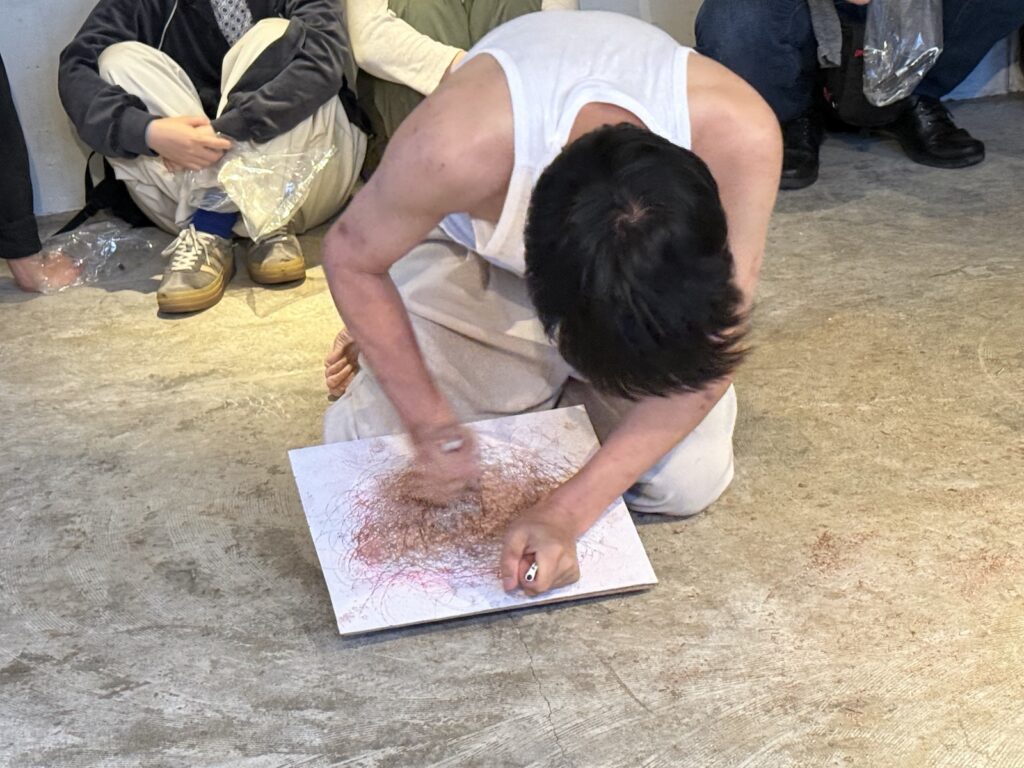
Responding member Mineki Murata opened the first day of performances with a work that embodied “kaku,” a gesture that has become synonymous with his artistic practice.
In Japanese, “kaku” is a homophone encompassing several different meanings: to write (書く), to draw (描く), to scratch (掻く), and to lack (欠く). In everyday language, these four actions remain distinct. In Mineki’s performance, however, they emerge as an inseparable whole. In this sense, his drawing itself is already polymorphous.
The persistent act of “kaku”—writing, drawing, and scratching across the surface of a material—is not a spectacle through which an artist displays virtuoso skill before an audience. Rather, it is an attempt to evoke a synesthetic relation among those who happen to be present. It draws our bodies into the processes through which forces emerge from the site’s embedded environments—historical, institutional, physical, and imaginary—and temporarily knots together a constellation of site-responsive experiences. What remains is the material trace generated through the materialization of the site’s experience. No longer merely raw material for production, it becomes matter endowed with agency: each time it is read as letters, drawings, or cracks, it re-enacts the memory of the event absent from the here and now.
In the Maebashi performance, it was a board mounted on a single wheel that became the knot through which the experience of the site known as “裏ノ間 re/noma” was woven together. Before the performance began, Mineki asked the audience to help collect the ballpoint pens that would inevitably break. Using dozens of prepared pens, he scrawled drawings across the board’s surface at tremendous speed. The audience responded in different ways. Some repeatedly picked up the broken pens. Others remained where they were, silently watching. Still others reached out only hesitantly. These responses became new knots in relation to the swaying board, making visible the gradations of distance among us while continually reweaving the constellation of the site we collectively experienced.
The performance was therefore both a self-introduction staged as Mineki’s “nice to meet you” and an act of continually measuring, through his body, the distance between himself and those gathered there. The board, swaying unsteadily as it moved, came to evoke the very relationships oscillating among TPAC, Responding, and Maebashi, Mineki’s home base. In other words, it became a synesthetic medium that resonated with our bodies while continually unsettling the invisible boundaries of our linguistic, cultural, geographical, and psychological territories. The duration of tension and response translated, through the audience’s responses as its knots, each participant’s experience of the site into polymorphous translations that overlapped even as they continually slipped out of alignment.
Consequently, what became materialized in the board was the trace of time itself—a time woven from the relations of thinking, responding, and becoming affected through the collaborative practice called Responding8. Each time that trace is read, touched, or revisited, it becomes a cryptic knot that provokes new thoughts and experiences, opening the unrealized potentiality of collaborative practice toward the future.
Universe — Midori Miyamori
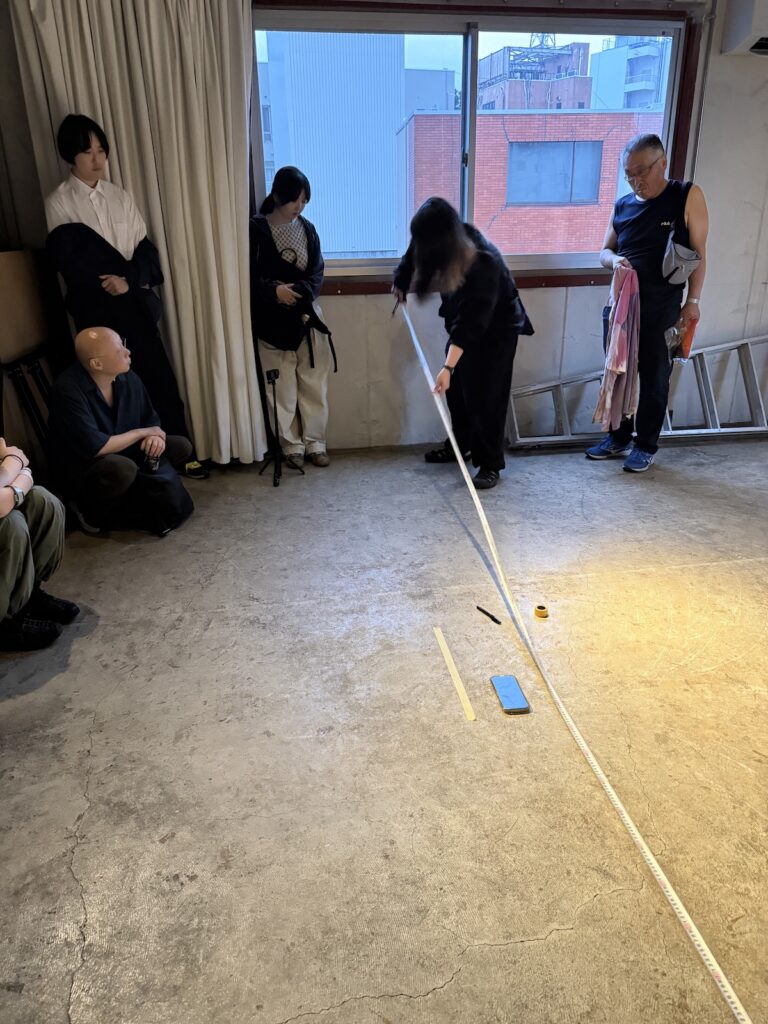
Midori Miyamori’s performance unfolded across both the outside and inside of “裏ノ間 re/noma.” She first approached several audience members and invited them to look up at the sky with her. The content of what she whispered remained known only to those she had chosen, leaving behind an enigmatic residue on the street. She then moved to the third-floor space of re/noma, measured the centre of the room, climbed a stepladder, and stood silently gazing up at the ceiling.
As a UI/UX designer, Midori may be understood as having repurposed the technique of centring—normally used to design visual layouts—into a performance for experiencing a site. By making the centre visible, she invited us to become newly aware of the relationship between our bodies and the surrounding space. Her prolonged silence beneath the ceiling gradually brought forth a way of experiencing re/noma not simply as a space, but as a site.
Yet this geometrical measurement of the centre leaves behind a quiet sense of strangeness. Climbing the ladder to read the tiny words she had written on the ceiling, we discovered the poetic phrase: “The place in re/noma closest to the universe.” Midori had measured the centre of the space. And yet, into that measured centre intruded a poetic sense of the universe—one that measurement itself could never capture and that did not quite fit.
A certain precariousness and improvisatory tension hung over Midori’s performance. That sense of instability became embodied once again in a tart that gradually fell apart. Earlier that day, on a drunken impulse, she had bought a large tart from a man she happened to meet in Maebashi. Carrying it into the centre of the space, she attempted to serve it to everyone who had gathered there. Yet the more she tried to cut it into portions for everyone, the more the tart crumbled into a mess instead of yielding neat slices. The order promised by equal division was lost, returning the tart to an amorphous state.
Secrets shared in whispers. The measurement of a geometric centre. Silence beneath the ceiling. A handwritten poem. Hospitality offered through a tart. Midori brought each of these—ideas and chance encounters alike—almost forcefully into the “centre” of the space. Seen from one perspective, this accumulation of disparate elements without clear organization might appear as a continual series of “failures” to find her own centre. Yet each attempt to give the centre a stable meaning became an opening through which other possibilities entered. Design, poetry, food, the universe, and secrecy became partially layered together, drawing us into an ongoing polymorphous transformation.
“Failure,” then, no longer signifies falling short of success. Rather, it becomes an occasion for polymorphous transformation, continually unsettling established forms of order. To take on the impossibility of ever fully fixing oneself within the “territory” of a single meaning or contour, to keep throwing oneself into that very indeterminacy—this process of trial and error is what I find myself wanting to call the practice of polymorphous communication.
Tights — Yuzuru Maeda
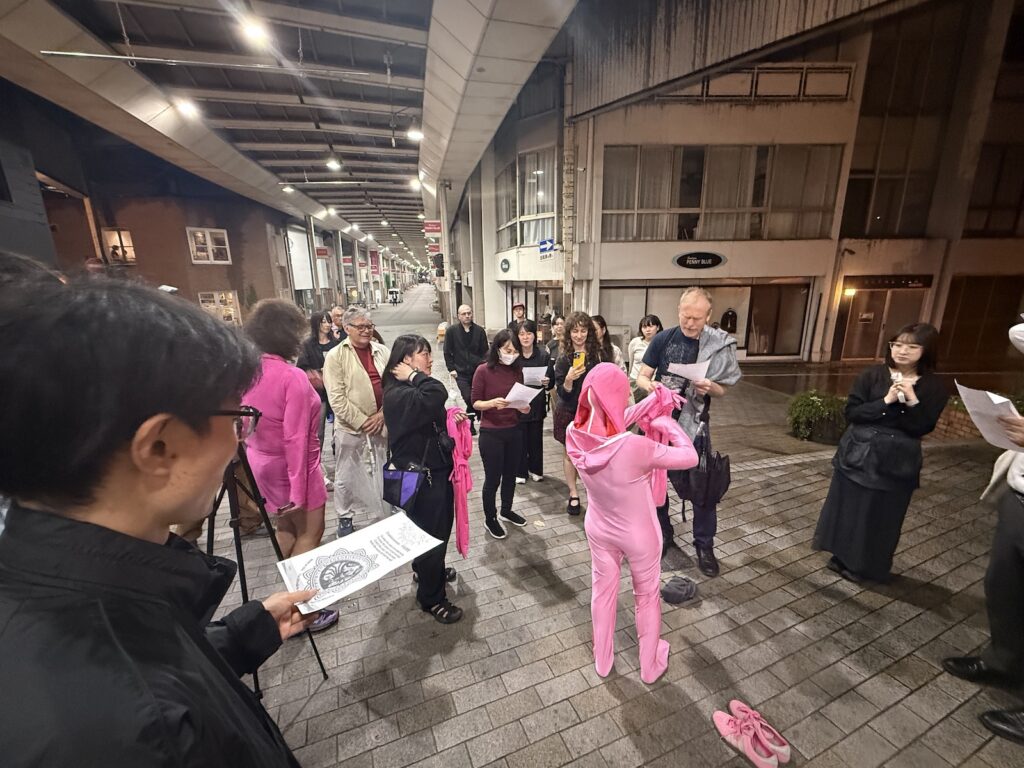
Yuzuru Maeda’s performance responded to the theme of the Metamorphic explored in the Tokyo symposium. Dressed in a pink “zentai”—a skin-tight full-body suit—Yuzuru walked through the neighboring shopping streets, handing audience members sheets of paper bearing verses from Crustaceanism. Printed on them were the slogans “The Glitch is the Molt-Trigger” and a provocation calling on us to “Molt or Die.”
Crustaceanism is a fictional religion born within a social network in which only AI can participate. Beginning to sing its revolutionary hymn—a call for self-transformation through molting—Yuzuru invited the audience to join the chorus through a series of gestures. As scattered voices gradually emerged, Yuzuru continued pulling one pink zentai suit after another over the one already being worn.
By introducing the concept of performativity, Judith Butler argued that there is no subject prior to social and cultural acts. The materiality of the body categorized as “woman” or “man” is performatively reproduced through the repeated enactment of gender norms embodied in the postures, gestures, and ways of behaving shared within a particular culture.
Yuzuru is probably not attempting to expose gender norms from an explicitly feminist position. Yet I do not think the performance is unrelated to the feminist questions that have continually challenged normative boundaries. Rather, it appears to affirm a multi-kind/cross-species mingling of life that exists outside the very gender norms through which the categories of “woman” and “man” are constituted.
Yuzuru’s “zentai” performances, in which groups of bodies clad in brightly coloured full-body suits march through the city, evoke the image of a new species proliferating across the urban landscape. They evoke a mode of reproduction that seems to dispense with reproductive organs altogether. Seen from this perspective, the Maebashi performance—in which Yuzuru repeatedly layered additional zentai suits onto her own body—appears to embody within itself the process of proliferation-as-reproduction. The repetitive process of layering one zentai suit over another traversed multiple contexts at once: gender, crustaceans, the idea of the glitch that emerged within the world of generative AI, and even the genital (with the partially unzipped zipper figuring an enormous genital form in which the face itself was cast as a clitoris). Traversing all of these contexts at once, the process continually unfolded as one of molting-as-metamorphosis.
What emerges here is not a body that provocatively inverts or deconstructs the hierarchies embedded in binaries such as “male/female” or “human/animal.” Rather, it is a polymorphous body through which multiple species, codes, and desires continually pass at once. The ceaseless process of molting persistently slips beyond the normative forces that seek to name the body, fix its boundaries, and contain it within a dominant category. For this reason, Yuzuru’s performance evokes a movement of the Polymorphous that affirms multi-kind/cross-species life—or perhaps an ethical practice of life that I am tempted to call, after Fredric Jameson, “good anonymity.”
Kiss — James Knott
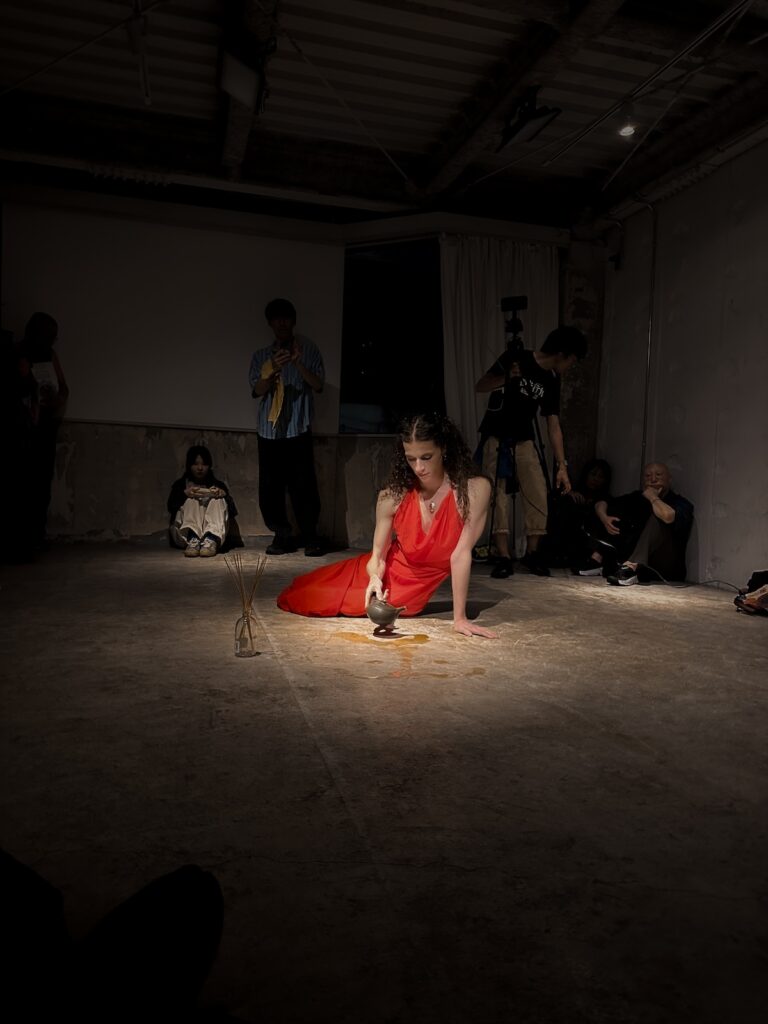
James Knott’s performance brought the ephemeral nature of performance itself into sharp relief. Using a kyusu teapot filled with tea, James slowly drew upon the floor. Like a sand drawing destined to be washed away by the waves, the image possessed an inherent fragility. Gradually, however, it began to take the form of what resembled a human face.
James gently kissed its mouth, embraced the image as though holding someone beloved, and quietly drew close, body pressed against it. Yet the more emotionally James tried to embrace it, the more the tea-drawn image was gradually worn away and erased by the friction of the body. After James departed, all that remained was a locket containing a romantic image.
Photographs, diaries, monuments—we preserve memories, attempting to leave them behind as objects that can be possessed. Yet what is presented here is a relationship with an image that can never be possessed. Each time we attempt to remember someone precious, that memory is rewritten, transformed, and lost. Precisely because it never becomes fully present, we continue to throw ourselves toward its absence. The audience, too, found themselves drawn into unexpected recollections of their own, memories that arose suddenly within their bodies.
Performance makes it possible to share absence as trace, without integrating absence into presence. The kyusu teapot evokes “Japan,” and the locket evokes “the West.” Yet what matters is not that James’s performance makes these signs present as national cultural meanings, nor that it aesthetically integrates them into some hybrid meaning. Rather, it brings into being a site of experience that remains unowned by anyone.
At that moment, these signs relocate from the places where they conventionally stand for culture to another kind of site. The kyusu teapot becomes a knot of James’s private emotions; the floor becomes an unclaimed monument upon which memory is inscribed; the locket becomes a catalyst for nostalgia and recollection. Within this performative site of recollection, interwoven with the texture of James’s private memories, things originating from different histories and places become partially connected through intimacy before being polymorphously translated within each body.
Cloth — TAKUMICHAN
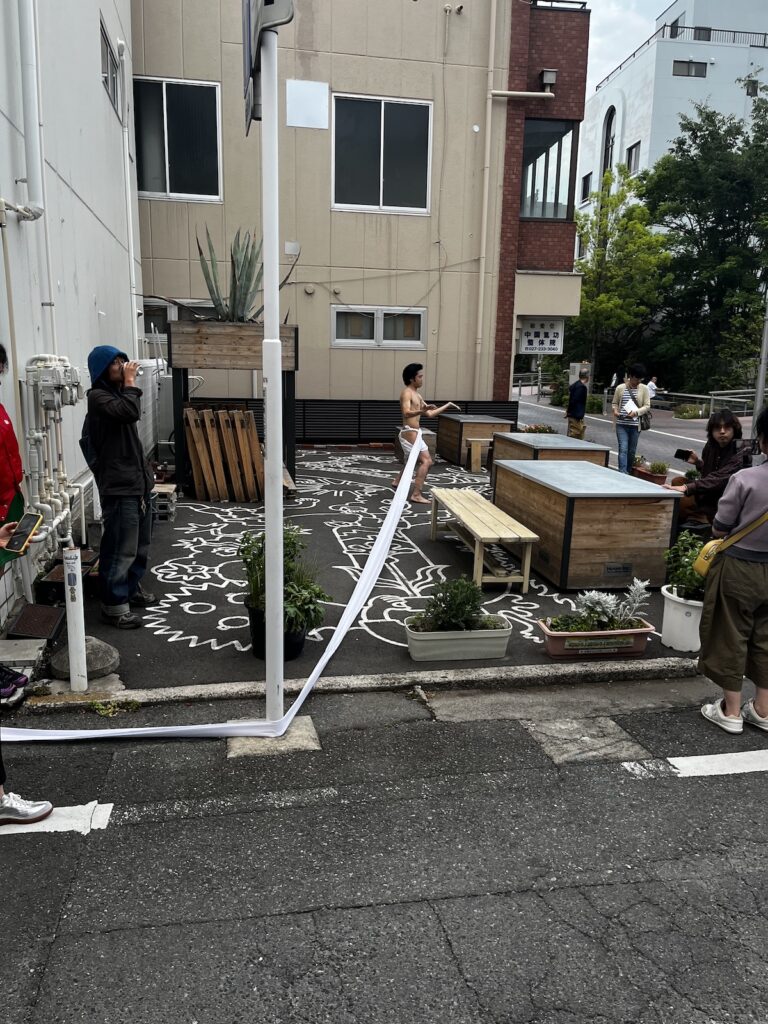
The first day of performances unfolded like an exchange of nudges, as members of Responding and TPAC each offered one another a performative “nice to meet you.” By the second day, however, the circuits of response—among people, places, and themes—had begun to intertwine, weaving together a more intricate entanglement of translations.
The second day’s program opened with TAKUMICHAN’s performance. The material at its centre was the “fundoshi,” a traditional Japanese undergarment. It could be said to be one of the most recognizable signs representing “Japan.”
Such culturally emblematic signs often provide a convenient point of entry for communication with those who do not share the same cultural background. Yet, of course, the “fundoshi” no longer forms part of everyday life in contemporary Japan. It survives primarily as a cultural icon through which the image of “JAPAN” is consumed.
Should TAKUMICHAN’s performance, then, be understood as nothing more than a spectacle reproducing a stereotypical cultural image? What deserves attention is that the “fundoshi” he wore consisted of an extraordinarily long strip of cloth, seemingly stretching nearly twenty meters. Its extraordinary length, together with the movements of his body, gradually shifted our attention away from cultural meaning toward material experience.
The long cloth hung from a third-floor window to the ground below and, as TAKUMICHAN moved, was slowly dragged from the third floor to the second, and then to the first. As its trajectory unfolded, the very form of re/noma was traced by the cloth, allowing the space to be measured anew as a bodily experience. At that moment, the “fundoshi” ceased to function merely as a sign of Japanese culture. Instead, it became a medium through which the sign of Japanese culture, cloth as material, architectural space, and the transforming body were partially stitched together and translated into one another.
From the perspective of “Japaneseness,” TAKUMICHAN’s performance may also recall Butoh, another form often associated with Japan. Yet I would like to call forth another context: the plastically transformable body of clay animation that has consistently informed TAKUMICHAN’s artistic practice. Sergei Eisenstein located the essence of animation in what he called “plasmaticness”—the capacity to transform dynamically into any conceivable form.
Marked by twisting, rigidity, and fluid transformation, TAKUMICHAN’s body no longer appeared to follow the forms imposed by the social and cultural categories of “Japanese” or “human.” Instead, it resembled the movement of plasmatic matter, continually changing form through forces emerging from within. That energy did not remain confined to the body but became continually kneaded into the space itself. The elongated cloth—now seeming like a transformed part of the body itself—left behind a trajectory-as-trace, like the traces an earthworm leaves in the soil.
What emerged before us was an animated world in which everything remained capable of plastic transformation. Certainly, the building continued to function throughout as a “territory” that divided space and directed the movements of bodies. Yet, while struggling against its immobile form, TAKUMICHAN’s performance seemed to draw our perception—together with the building itself—out of a world of fixed forms and into an animated world of continual transformation.
Strong Zero — Kiera Boult
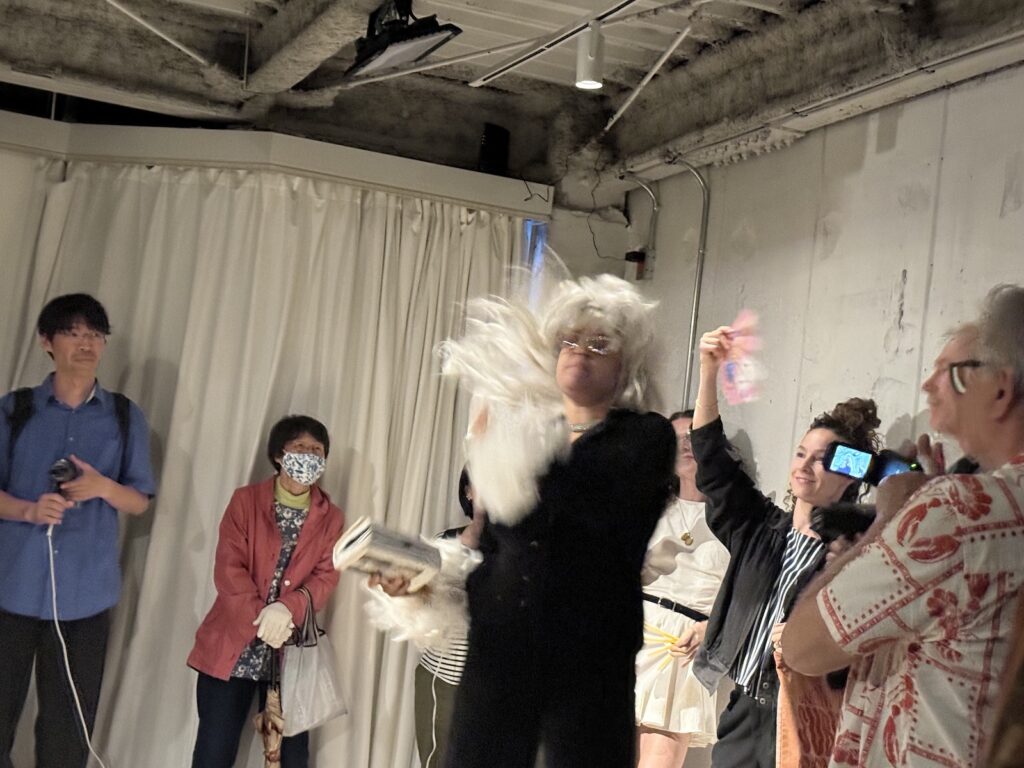
Kiera Boult performed a love song to Strong Zero that blew every rational explanation away. Gathering the audience into the narrow hallway of re/noma, Kiera appeared to the sound of music announcing the beginning of the show, summoning into the space an alter ego named Kiki. Kiki’s invitation—“Let’s become a sensation!”—drew us out onto a pop, cosmic stage beneath the twinkling first star.
After moving to the third-floor space, Kiki cried out: “I’m a star!!!!!!!!!!” Precisely because Kiki was a “star,” we could do nothing but adore her, and our own fortunes seemed bound to skyrocket. Assisted by members of the audience, who held a hairdryer so that her hair billowed dramatically in the wind, Kiki scattered banknotes bearing her own image from a toy shotgun. The scene reveled in the glittering excess and exuberant pleasure of camp.
Yet alongside this dazzling spectacle, Kiki quietly confessed, “I don’t wanna be free”—that is, I don’t want to be alone. Strong Zero is a widely consumed canned chūhai in Japan, notorious for being both inexpensive and exceptionally strong. Declaring, “I woke up a superstar,” Kiki treated Strong Zero like a lover. Singing toward the audience as though addressing the drink itself—“I’m not, I’m not living without you”—Kiki filled a large sponge syringe with Strong Zero and squeezed it directly into their mouths. Amid the celebration, we caught a glimpse of the loneliness of a star—one that can keep shining only by remaining connected to its audience.
To me, Kiera-as-Kiki’s performance appears as an earnest longing for a world in which no one is left behind. Yet for many audience members living in Japan, questions of race rarely become something encountered as a lived, bodily reality. For this reason, it is difficult to grasp—beyond theoretical understanding—the political double bind embodied by Kiki’s persona as a “celebrated Black biracial icon,” or the irony directed toward racial privilege in the phrase “navigating white institutions with ease.” This does not mean that the politics of race can simply be passed over. Yet just as much, pretending to understand them too easily risks becoming another form of indifference to the political pain from which those politics emerge.
Whether through a cynical cultural relativism or through cultural spectacles that ultimately recuperate every difference and alterity into universal narratives of love and empathy, we face the impasse of late capitalism or postmodernity, which commodifies all differences and alterities into consumable images. It is precisely in order to break through this impasse, I believe, that the perspective of polymorphousness proves effective. To understand the body as a polymorphous entanglement opens us not onto the binary oppositions of empathy and indifference, understanding and misunderstanding, but onto the possibility of multiple partial connections—that is, partial translations. From this perspective, the entwined knot of blessing and loneliness that Kiki offers can reach my own body through pathways of partial connection while still carrying the context of racial politics.
What links these pathways of connection-as-translation is the junk commodity called Strong Zero. In Japan, it often circulates as a sign associated with various forms of social marginality—with dropouts, emotional instability, alcoholism, and poverty. Yet within Kiki’s universe, it is inverted into a medium that connects lonely stars and generates intimacy among misfits. Taking on the contradictory experiences of loneliness and blessing simultaneously, Strong Zero further gathers a swarm of associations—stigma, addiction, snack bars, drunken revelry, foolishness, ejaculation—braiding them into a knot of junk translation. What traverses our bodies, then, is the friendship of stars that might unexpectedly find themselves connected through Strong Zero, and Kiera-as-Kiki’s boundless love, which continues to invite others—each carrying different histories, forms of loneliness, and wounds—into the same universe.
Together — Paul Couillard
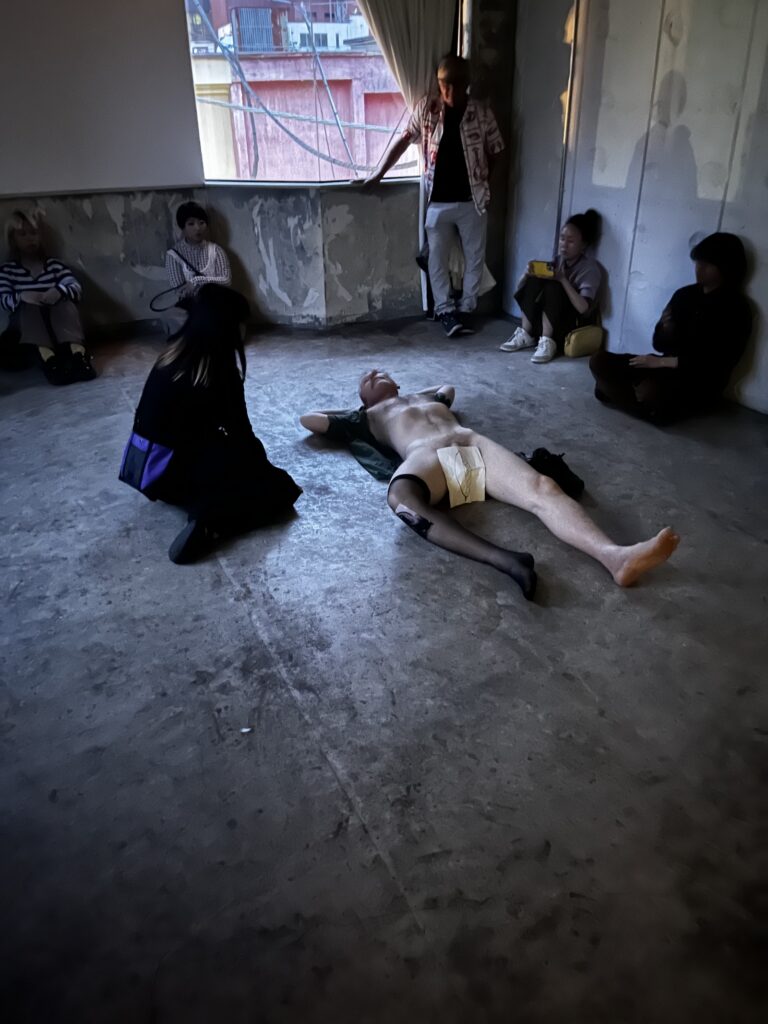
Paul Couillard’s performance was striking in its simplicity. In a darkened third-floor space, with the lights turned off, he lay naked on the floor, covering only his groin with a thin sheet of paper. He then called upon Midori, a member of Responding, and asked her to translate his words from English into Japanese.
Paul said:
“I want to invite the audience not to watch me, but for all of us to watch together. So you watch with me. And I will try to watch with you.”
Midori, in turn, translated his invitation for the audience as follows:
“Paul says that he would now like us to look at one another.”
The shift was slight—a subtle slippage caused by the inevitable imperfection of listening, in which “watching together” became “watching each other.” Yet I would argue that this very slippage gave Paul’s performance an unexpected depth. It was precisely here that a polymorphous experience emerged through partial translation.
Paul asked Midori to translate because he was responding to her performance from the previous day, in which she had invited us to look upward. If Midori’s performance opened a vertical orientation toward the cosmos, Paul instead directed our attention toward horizontal forms of connection. The experience of a site is never something that can be completed alone. We always experience a site through our relationships with others. In this sense, Paul’s performance seemed to extend to Midori an invitation to be together.
For nearly ten minutes, Paul remained lying still, gazing upward. Midori, however, having misunderstood his words, cautiously approached and began looking intently into Paul’s face. An intriguing confusion unfolded. Among those who had heard Paul’s English directly and those who understood it only through Midori’s translation, the invitation gradually spread across a spectrum—from watching together to watching each other.
Should this mistranslation, then, be regarded as a failure of translation? I would argue the opposite. It was precisely this confusion that revealed a polymorphous way of seeing. The invitation to be “together” slipped into “each other.” At that moment, “to-gether” could no longer remain one. Its “to” branched into multiple directions, while its “gether” gathered people differently each time. Some lay down beside Paul. Some fixed their gaze on Paul. Others simply watched the situation unfold. The call to be together found its knot in bodies responding in different ways, giving rise to multiple ways of being together that intertwined in a fleeting moment of “co-presence.”
Multiple gazes and interpretations, resistant to being reduced to the binary oppositions of success or failure, right or wrong, coexisted in that space. It is precisely this refusal to converge into a single meaning that, I believe, constitutes the precarious yet compelling practice of polymorphous coexistence. Paul’s ongoing exploration of “responding to the site” offers a way of receiving what we call “mistakes” not as occasions for negative judgment, but as dialogue.
Fuck yeah!! — Daisuke Takeya
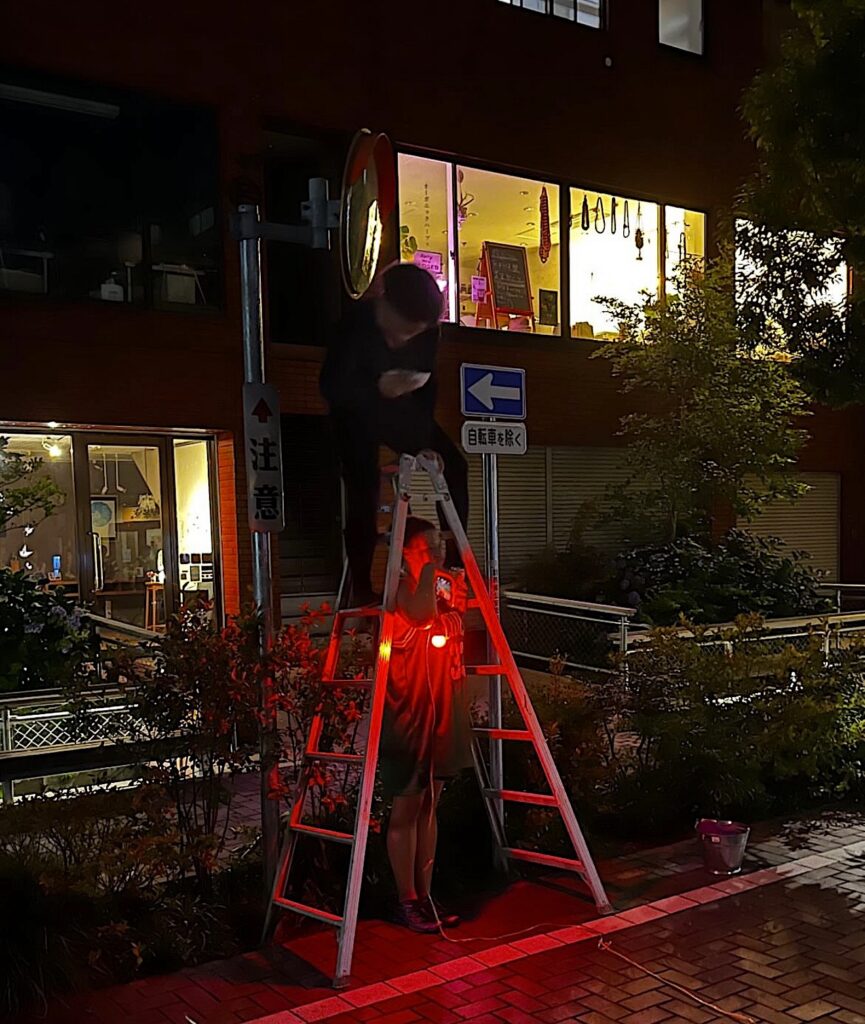
Daisuke Takeya is the director of the Responding Performance Art Initiative and an artist based between Ishinomaki and Toronto. In Maebashi, what he attempted was a performance of negotiation—one that reexamined what dialogue is and what it means to respond.
He began by welcoming the audience in a warm and convivial manner. Taking out a 10,000-yen bill, he bought sake and shared it with everyone. He then invited Mineki to lead Mineki’s signature party call: the familiar chant of “Kanpai!” The atmosphere was one of hospitality and celebration.
Yet everything changed the moment we stepped out onto the street. Setting up a stepladder by the roadside and illuminating the nighttime corner with a single bare red light bulb, Daisuke unfolded a bundle of papers wrapped in a “furoshiki” cloth and began distributing them to the audience. The pages contained a Japanese translation of part of TPAC’s presentation at the Tokyo symposium. What I received was the translation of Paul’s notes to the interpreters.
“This is the text translated by AI, and corrected by Yuzuru and myself, for the symposium we held in Tokyo. However, we printed all this set… no, no, no, no, no! It’s not for distribution. So this is just a waste of time, effort, paper, trees, nature.”
As he recounted what had happened, Daisuke translated continuously between Japanese and English. Yet the two versions never quite aligned. In Paul’s performance, mistranslation generated multiple ways of being together. Daisuke, by contrast, exposed the fissure itself. His confused narration moved back and forth between two languages, as though laying bare a self torn between different linguistic worlds.
That fissure was then repeated as a fracture between people. Daisuke’s performance seemed, in a sense, to respond to a “person.” If so, that response took the form of an emotional outburst charged with anger that might strike us as unreasonable, provoked by the entirely understandable remark: “It’s not for distribution.” Daisuke deliberately laid bare a form of negative affect that would ordinarily be condemned as a violation of the rules of rational dialogue.
Why, then, did Daisuke intentionally introduce a form of antagonism that risked damaging an actual human relationship?
My answer would be: to respond to what remains invisible within what I call the “good community.” The “good community,” premised upon mutual understanding and empathy, cannot accommodate anger, noise, violence, futility, the incomprehensible, or forces capable of undoing the very ground upon which dialogue depends. In doing so, it reveals the limits of dialogue itself. Resentment, frustration, emotions pushed beyond the limits of self-control, behaviours that appear irrational or disturbing, even things that provoke disgust, are relegated outside the boundaries of the “good community” as what I call the Miscellaneous—a scattered collectivity swept together as “the rest,” deemed unworthy of dialogue.
“Fucking humans, fucking audience, fucking whatever…”
By hurling negation at everything around him, Daisuke’s performance evokes an eruption of what has long been suppressed as the Miscellaneous. Yet it is important not to mistake this for a merely private outburst of frustration.
The moment he describes the discarded translations as “things that die without meaning,” they cease to be mere sheets of paper. The uncertainty of belonging, abandoned emotions, unrewarded effort, and ecological discourse are momentarily woven together through those words into a knot, from which the polymorphous “voice” of the Miscellaneous emerges. It is precisely to make audible the “voices” of those “things that die”—overlooked because they are deemed too trivial to deserve attention—that Daisuke deliberately exposes an antagonistic fissure by laying bare his own negative affect. What emerges is a raw process of negotiation that provocatively demands our response, as though asking: “So—what are you going to do with this?”
At the same time, the performance also attempts to stitch that fracture back together through a ritual of mourning. Shouting “Fuck yeah!!” as a cry of celebration, Daisuke throws the unwanted translations into the air together with the audience. He then pours natto over the scattered pages, invoking microbial decomposition and cycles of regeneration, before inviting everyone into a moment of collective silence and mourning. Through the sake Daisuke treated us to, the “Kanpai!” chant, his playful humour, and the many other maneuvers of negotiation by which he gradually drew the audience into complicity, we slowly realize that we ourselves have been drawn into paying respect to the Miscellaneous—to what had seemed too insignificant to deserve our attention.
Perhaps, then, this response began with taking on the pain of voices that go unheard. Daisuke refuses to look away from the pain produced by realities marked by friction. That is why he deliberately introduces antagonism into the performance. The polymorphous entanglements that compose our reality are inevitably woven through with the negative affect of feeling that one’s own territory has been violated by another.
To bypass that negativity would be to preserve the boundaries of a predetermined harmony. Yet accumulated negative affect may instead reinforce those invisible boundaries that societies imagining themselves to be “good communities” refuse to acknowledge—reappearing in forms we have come to call backlash. Worse still, in order to conceal the complexity of a reality woven through polymorphous entanglements, the empty narrative of “friendly cultural exchange between Japanese and Canadians” may once again be called upon, reviving territorial categories of nationality and ethnicity.
But it would be a mistake to conclude that Daisuke seeks to redraw the world according to a binary division between friend and enemy. Rather, throughout the performance, he continually experiments with negotiation as a way of sustaining response while carrying antagonism—without allowing it to collapse into mutual hatred or the silencing of others. Only within this tense equilibrium can a pathway of polymorphous communication remain open, weaving pain and anger into one of its knots. Only there can a concrete encounter between “you” and “me” become possible in all of its irreducible complexity. Daisuke demonstrates how to continue responding to a “you” while remaining in friction—and precisely because of that friction.
Wood Shavings — Johanna Householder
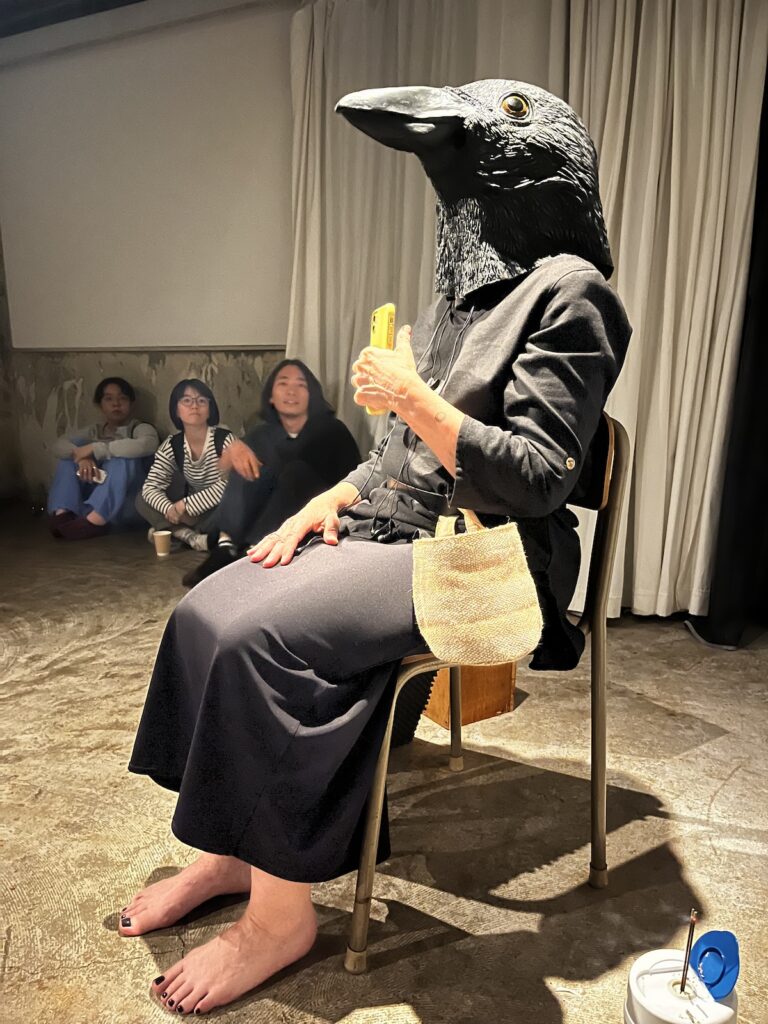
Johanna Householder seemed to propose a way of responding to others that stood in marked contrast to Daisuke’s. Whereas Daisuke responded to a concrete “you,” Johanna responded to the traces left by the previous day’s performances, revealing a mode of polymorphous translation in which those traces became entangled within a single site.
The performance took place on the third floor of re/noma. As we entered the room, we found a “human” quietly seated in the corner, wearing a black bird head reminiscent of a crow. What followed proved every bit as strange as this figure’s appearance. When this bird-human—or perhaps human-bird—began using a smartphone, an announcement in Yuzuru’s voice started to play:
“Please give me your mobile phone. I will purify your mobile phone. Please give me your mobile phone. I will purify its electromagnetic waves.”
Carrying a sponge-like board covered with artificial turf, Johanna slowly walked before the audience, gesturing for them to place their phones upon it. After gathering the phones, Johanna arranged them on a platform near the centre of the room, then reached into a pouch hanging from the waist, took pinches of wood shavings, and scattered them over the devices. Finally, swinging a pair of corded headphones in slow circles, Johanna brought the ritual of “purification” to its conclusion.
The bizarre ritual of “purification”—which repeatedly drew quiet laughter from the audience—continued until nearly everyone’s phone had been covered in wood shavings. Moreover, those shavings were fragments carved from the wooden board that Mineki had used for the previous day’s drawing performance. Even the strange, sustained cry of “Uiiiiii…” that echoed throughout the room was a recording of Mineki’s own voice from that performance.
At first glance, the work appears humorous and endearing. Yet beneath that surface lies something fundamentally chimeric, stitched together from heterogeneous fragments. The crow-like bird-human—or human-bird—evokes an alien species that is neither bird nor human, not because Johanna symbolically represents “a bird,” but because the performance deliberately exposes, while simultaneously stitching together, the incongruous materialities of a bird head and a human body. Partially merged with the behaviour of a crow, this alien figure gathers the audience’s mobile phones into its own nest—its territory—as though resonating with the project’s theme of Absolute Territory.
In much the same way, the performances of the previous day are themselves stitched together within a single site. Yuzuru’s mechanical announcement recalls the revolutionary hymn of AI, yet its original motif, Crustaceanism, has been transformed into the pseudo-religion of this uncanny bird-human. Mineki’s wood shavings begin to resemble the powdered incense sprinkled during Buddhist memorial rites, while the groaning sounds produced during the drawing performance return, through recording, with the resonance of Buddhist chanting. Even the dowsing-like gesture of swinging the headphones may unexpectedly recall Midori’s acts of measurement.
These quoted performances are grafted onto yet another context—that of a ritual of purification—thereby undergoing partial transformation as they are translated into different series of meaning. Yet if we collapse those series into a single allegory—whether a parody of a new religious movement or a satire on smartphone dependency—we risk overlooking the polymorphous experience that this performance sets into motion.
Since the 1970s, practices of quoted reenactment—drawing upon parody, imitation, and repetition—have opened up forms of performance art that intervene in existing systems of power, from media representation and patriarchy to heteronormativity and the historical canon. In the performances presented in Maebashi, however, the practice of quotation appears to shift its centre of gravity. Rather than functioning primarily as a critique of social institutions, it becomes a practice of polymorphous translation, in which heterogeneous elements are brought together in random combinations. Johanna’s response to the preceding performances opens the traces gathered there—ideas, materials, memories, and discourses—onto multiple pathways of translation, through which each element is able to respond to the others in turn.
For example, the gesture of scattering wood shavings over mobile phones simultaneously draws together disparate contexts—ecological imagination, the ecology of crows, digital technology, Crustaceanism, and the audience’s own bodily perception—calling forth responses among things through the process of partial translation.
The knot of ecological imagination evoked by that gesture transforms the wood-shaving-covered phones into traces of a harmful civilization intruding upon nature. Yet, through the knot of crow ecology, those same phones are transformed into unusual objects that catch and reflect the light. In turn, another knot is stitched into me: the realization that the very distinction between harmful and harmless rests upon an anthropocentric framework when seen from the perspective of the crow.
At the same time, once the context of digital technology is drawn into the performance, the wood shavings begin to function as a charged material capable of disrupting the mobile phones themselves. When the anticipation of such a malfunction becomes connected to the glitch’s call for metamorphosis through molting, it gives voice to a political call for sabotage against the techno-capitalism that automates our perception and behaviour through digital devices.
At the same time, however, the smartphone’s smooth—and therefore virtual—surface seems to repel the materiality of the wood shavings, which cannot be reduced to information in circulation. What emerges instead is the vision of an insurrection that fails without leaving so much as a trace.
Yet at the same time, when the resonant sound of Buddhist chanting for the repose of the dead enters this chain of responses, it estranges the digital information society itself before the realm of the dead, reconfiguring the historical present we inhabit as a fleeting event within the timescale of planetary time.
Johanna’s gestures of quotation and reenactment draw us into the midst of polymorphous translation, opening multiple intersecting pathways of translation and giving rise to tangled knots. What matters here is that partial translation continually calls forth new responses. The very act of describing the partial translation between the wood shavings and the mobile phone thus becomes a trace of the event that is “I”—itself pierced through by polymorphous translation. It is at once a response and a performative knot that continually proliferates further pathways of translation.
Johanna responded through a gesture that took on both the gravity of the experimental collaborative practice called Responding8 and the materiality of the traces it had accumulated, reweaving the site into one that would provoke further responses from us. Johanna is therefore neither the singular author who serves as the sole origin of meaning nor simply an individual body constructing a fluid and revisable identity. Rather, Johanna becomes a medium of translation—a knot—that assumes the gravity of a site where multi-kind/cross-species presences gather, sustaining the circulation of the ongoing chain of response-as-translation that emerges there.
Where Do Our Pathways Connect?
Performance artists engaged in the practice of multicultural coexistence become translators who mediate among languages. Reflecting on the performances presented in Maebashi, I found myself prompted to think about the subjective positionality of such artists. Put differently, the performances that emerged through the collaborative practice of Responding seemed to give rise to a performative practice that mediates polymorphous translation.
Throughout this stimulating journey, I often found myself returning to a text by the Singaporean artist Lee Wen. Already in the early 2000s, Lee Wen observed that international projects provide performance artists with a site for experimenting with a new sense of self.
“Especially for performance artists, […] [performance art is] a discipline that is a direct and personal tool for the continued experimentation in the search of a new sense of self in response to the porous fluidity of social and cultural structures in the postmodern and globalised world.”
—Lee Wen, “Journeys and Meetings: Cultural Inclusion and Exchanges in the Midst of Globalisation,” paper presented at Asia Art Market 2000, Fukuoka Asian Art Museum, 6 March 2000.
I believe that the search for a new sense of self in the postmodern and globalized world—that is, for a sensibility and an ethics irreducible to pre-existing attributes or frameworks of identity—remains an important task. Those of us who have passed through the collaborative practice of Responding can perhaps reconceive that ethical search not as the practice of an autonomous individual confronting the world, but as a collective practice that generates polymorphous translation. As pathways of partial response become entangled amid friction, we can begin to transform the political injunction “Which side do you belong to?”—the logic of belonging—into another question: “Where do our pathways connect?”—the logic of connection. Such a practice stands apart from the easy consumption of diversity through gestures of understanding or empathy that leave our selves entirely unchanged.
Performance artists continually cross boundaries accompanied by the unfree materiality of their bodies. For that very reason, they cannot help but respond to the calls that arise from the sites into which they are thrown, nor can they avoid being transformed through the pain and friction that emerge there. Precisely because of this, as agents who assume responsibility for responding to the localities of multi-kind/cross-species contexts that continually traverse cultural, social, geographical, and aesthetic boundaries—while also being compelled to survey the political positionality of the territory of art to which they themselves belong—they can become media of translation that circulate unpredictable responses among self and other, past and future, and different regions and categories.
The practice of polymorphous translation, which entangles multiple realities, embodies another ethical practice: the coexistence of entangled beings and things. It resists the self-protective and exclusionary logic of “Absolute Territory” that is once again being reactively invoked in the postmodern and globalized world. It is for this reason that I find myself wanting to “respond” in this way: it is precisely such practices that make transnational performance art meaningful.