

I hold live performance sacred. I consider it among the most vital, the most human, and the most immediate forms of contemporary artistic work. With this belief I continually return to live performance as an igniter of ideas and imagining. I endeavour to experience as much performance as humanly possible and have done so throughout my life. This includes attending performance art events in Toronto where I live, a city with a robust performance art community, along with experimental theatre, live music, community theatre, and large-scale festival productions. Quite simply, I remain consistently enraptured by the creative potential of all forms of human performance.
I was invited by curator Paul Couillard to write about 7a*mgr8 in September 2025. The following month, I prepared to watch performances as they were shared to the 7a*11d website. The project launched in 2024, with three artists engaged for the first iteration. Seven artists were engaged to create work in 2025. Initially, I was unsure where to begin. I felt that to properly discuss the scope of the works, I would need to wait until I had seen everything that would be included in the project. I understood it to be an online initiative taking place in a year when the in-person performance art festival 7a*11d was not scheduled. I knew 7a*mgr8 performances would be shared gradually, yet I still felt an entry point for my analysis was missing. Of course, I understood the intention of the initiative: intergenerational dialogues, new works created in response to those accessible via the digital archive, a continuation of performances initiated in the past, and that the response pieces would be the resulting output of 7a*mgr8. With such an expansive archive, and total freedom of choice granted to the artists, it was hard to conceptualize how the resulting output of 7a*mgr8 might look.
7a*mgr8 performances were first presented in 2024, with works by Sean Lee, Tanya Lukin Linklater, and Abedar Kamgari. I was given access to an intimate virtual artist roundtable among those artists, recorded in 2024, as my first engagement with 7a*mgr8. As this conversation is not viewable online, I hesitate to cite it, but I can share that the dialogue between the three artists and Paul was captivating. I was immediately inspired by the framework of the project. I have personal experience being transfixed by a performance that lingered in my memory, even if only as a brief moment I witnessed or as described to me by someone who was in attendance. My imagination was spurred, although I knew there would still be a great deal to explore before I could begin reflecting on the project.
An in-person event helped ground my understanding of key considerations that became part of 7a*mgr8 as a digital initiative. I was invited to a dinner and long table discussion in December 2025 titled The Work of the Artist-Archivist in the Age of Machinic Devouring held at The Commons in 401 Richmond Street West in Toronto. The event began with an informal meal which consisted of shared food in a relaxed open format. It was well attended, although I recognized only a few familiar faces from the Toronto performance art community that night. The by-invitation evening was not announced as an official 7a*mgr8 launch, although I understood there to be an affiliation. Over the course of the evening, between the informal conversations during dinner and subsequent long table discussion, I began to get a sense of the overarching questions about both digital archives and the significance of digital performances that were being created for 7a*mgr8, particularly in the current moment of increasing reliance on technology for information sharing.
Following the meal, two video performances were streamed in the screening space of the Commons. These were not performances that would be included in 7a*mgr8; however, one of the two artists who appeared via Zoom that night, Pam Hall, was a selected 7a*mgr8 artist. The other artists were the Ecuadorian collective Pachaqueer, who participated via Zoom from Ecuador. A wonderfully rich long table discussion followed the screening, focused on digital archives and the current moment, specifically the rampant emergence of artificial intelligence and its associated digital consumption, or “machinic (sic) devouring”, the term used in the event’s title.
Attendees were free to take a seat at the long table to contribute to the discussion. This was, however, entirely voluntary. I chose not to speak; rather, I sat back and absorbed the experience. Although some speakers offered their names, self-introductions were quick. A generational divide was evident in the attendees who shared, as the age range of speakers was quite broad. Younger attendees who spoke, identifying themselves as students in undergraduate programs, seemed apprehensive at the inescapability of the impending digital devouring in the current moment: Archives are increasingly digitized, data is inescapably analyzed, all to what end? While I sensed an underlying concern in many of the comments made that night, others expressed a sense of amazement at the sheer volume of archival information now available online. I jotted down a statement made by one attendee: “Information is not knowledge.” I left the event at 401 Richmond that night reflecting on the tone of genuine apprehension expressed by many in attendance. Alongside this was clear amazement at the possibility and creative potential unrestricted access to digital archives can provide.
Over the months that followed, individual artists’ response works for the 2025-26 7a*mgr8 series were gradually added online to those from 2024. The performances were accompanied by a recorded artist talk between the artist and the original creator or creators of the work they had responded to, moderated by 7a*mgr8 curator Paul Couillard. I watched individual performances periodically over the winter, making handwritten notes throughout. I also watched – and in some cases re-watched – each artist talk. The rich discussions about performance have continued to reverberate over the time I’ve worked on this piece of writing. I’ve frequently been reminded of the statement made during the December 2025 dinner event:
information is not knowledge
The 7a*mgr8 artist’s talks freely shared such deep knowledge about performance and artistic cultural histories in Canada, from both the creators of each original work and the artists selected to respond to their work.
Although not intentional, I didn’t view 7a*mgr8 performances in the chronological order in which they were released. Instead, I periodically watched one performance at a time, in random order, followed by the recorded artists’ talk. This frequency resulted in the sensation that I was immersed in these works for months, throughout a particularly dark and difficult winter. I languished in this slow process, taking notes, watching, writing, and returning to re-watch key moments again for each performance.
The response works varied in presentation. In some, any connection to the original was not immediately perceptible. Bridget Moser’s piece for 7a*mgr8 is entirely sound-based, while Andrew James Paterson’s performance in 1997 began as a monologue performed for a live audience. Paterson commented during the recorded artist talk that upon seeing Moser’s work he did not make any association whatsoever to his original piece. He was nonetheless flattered and mentioned being glad something was gleaned from his work. On my first listening of Moser’s performance, I might have agreed with Paterson, however a synchronicity between the two works sprung out at a moment when, in the 1997 performance, Paterson appeared on multiple cameras, with voice-over recording played into the performance space. The synchronicity that stood out was the approach and delivery of the two artists, despite other differences such as age and the time span of nearly thirty years between these two works. Both Moser and Paterson incorporate absurdity into their work; alongside this absurdity each are highly intellectual.
Bridge MOSER, Bone Conduction (It’s in My Blood) (audio with closed captions). 7a*mgr8 2025 © Bridget Moser
Andrew James PATERSON, Performance: A Performance. 7a*11d 1997 © Andrew James Paterson
Santiago Tamayo Soler’s piece is visually a significant departure from François Morelli’s original work, Mari usque ad Mare / D’un trou d’eau à l’autre / Piss and Vinegar, which was performed inconspicuously in 2018 at various public fountains. Tamayo Soler’s response work is highly stylized. It begins with a long establishing shot and title credit. I was reminded of the introduction to a video game, although gradually small harmonious details such as fountains and the sandals Morelli included in his work appeared, digitally rendered. Tamayo Soler’s highly stylized approach was both immersive and captivating, despite departing from a traditional presentation of performance when considered alongside other works in 7a*mgr8. Tamayo Soler is primarily a video artist, so this reflects the nature of his practice. The visual strength of the piece – the multiple perspectives displayed on screen at once, the many details included in each shot – have lingered in my consciousness.
Santiago TAMAYO SOLER, SAN ISIDRO LABRADOR: Rituales para Invocar el Agua (video). 7a*mgr8 2025 © Santiago Tamayo Soler
François MORELLI, Mari usque ad Mare / D’un trou d’eau à l’autre / Piss and Vinegar. 7a*11d 2018. VIDEO Alan Peng & Jeff Zhao © François Morelli
The works by k.g. Guttman and Claudia Edwards were closer to the types of response I envisioned would be created for 7a*mgr8. Each share a re-interpretive quality to the works they have responded to, in contrast to the pieces by Bridget Moser and Santiago Tamayo Soler. Despite a lack of prior professional connection between Guttman and Edwards to the artist (or artists) who had created the original works — in contrast to Soler, who had been a student of Morelli, and Moser, who is friend to Paterson — Guttman’s and Edwards’ artist talks displayed evident mutual admiration, warmth and genuine investigation of intention of the works they responded to. Guttman described being moved upon viewing the work created by Pam Patterson and Leena Raudvee, and indeed Guttman’s response piece seems to share a sensorial essence of the original work. In both the original and the response piece, a camera person followed the performers’ specific motions. Both were filmed in one take with minimal editing, and took place in highly specific locations. Guttman’s collaborator in her piece however is her daughter, a seven-year-old child. Together they trace a path through their Montreal home, as opposed to the public space Pam Patterson and Leena Raudvee traced in the hallways of 401 Richmond in Toronto in the year 2000.
k.g. GUTTMAN, pas sûre what’s moving what. 7a*mgr8 2025. VIDEO Kinga Michalska © k.g. Guttman 2026
ARTIFACTS (Pam PATTERSON & Leena RAUDVEE), Passing. 7a*11d 2000. VIDEO Paul Couillard © Pam Patterson and Leena Raudvee
Claudia Edwards’ response to Erika DeFreitas’ work shares a careful, thorough consideration of objects, the histories woven into objects, and emotions generated by objects such as heirlooms or family photographs. The dialogue between Edwards and DeFreitas in their artist talk is ruminative and gentle. Edwards described the considerations that went into their work, such as the process of immersing a book in water, and their sensations interacting with archival objects. Their talk reflected on feelings generated by archival exploration, as both artists selected deeply personal objects to incorporate into their featured performances. Having undertaken similar deeply personal archival research, this conversation resonated deeply. I too have unquestionably experienced the emotional charge and subsequent rush of complex feelings that result in the exploration and tactile engagement with archival objects.
Claudia EDWARDS, Palimpsest. 7a*mgr8 2025. VIDEO Peppercorn Imagine and Claudia Edwards © Claudia Edwards
Erika DEFREITAS, nothing ever so straight. 7a*11d 2018. VIDEO Alan Peng and Jeff Zhao © Erika DeFreitas
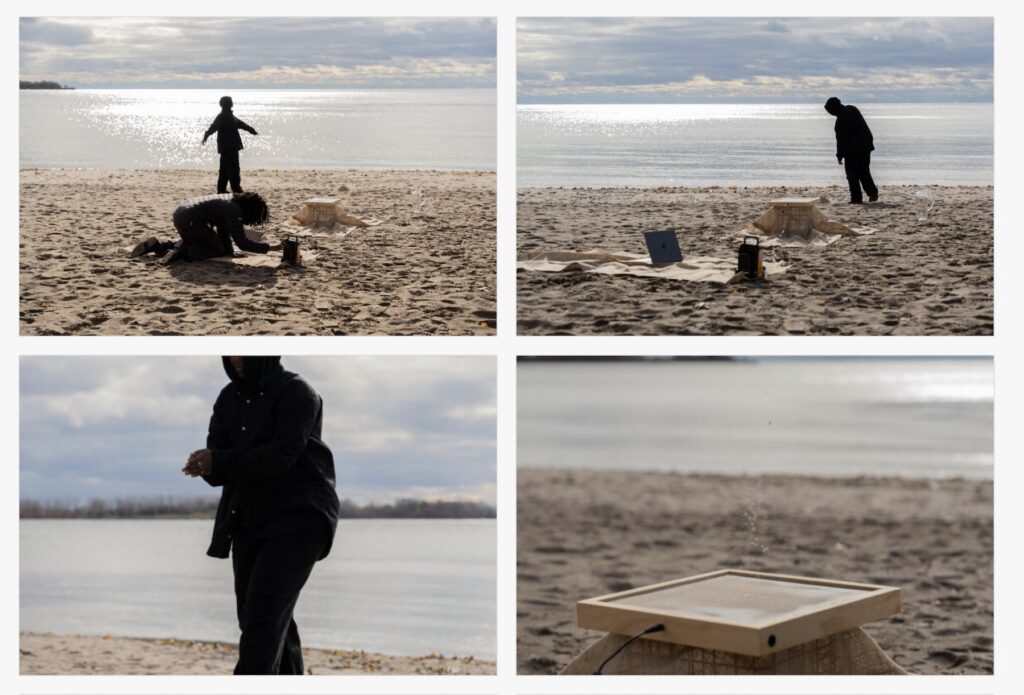
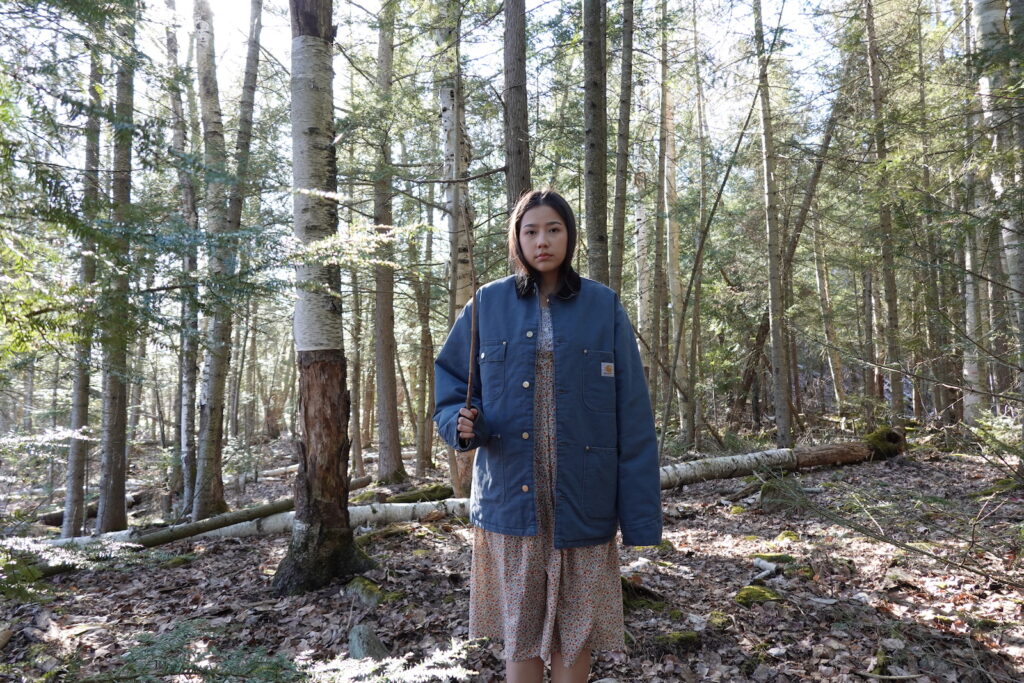
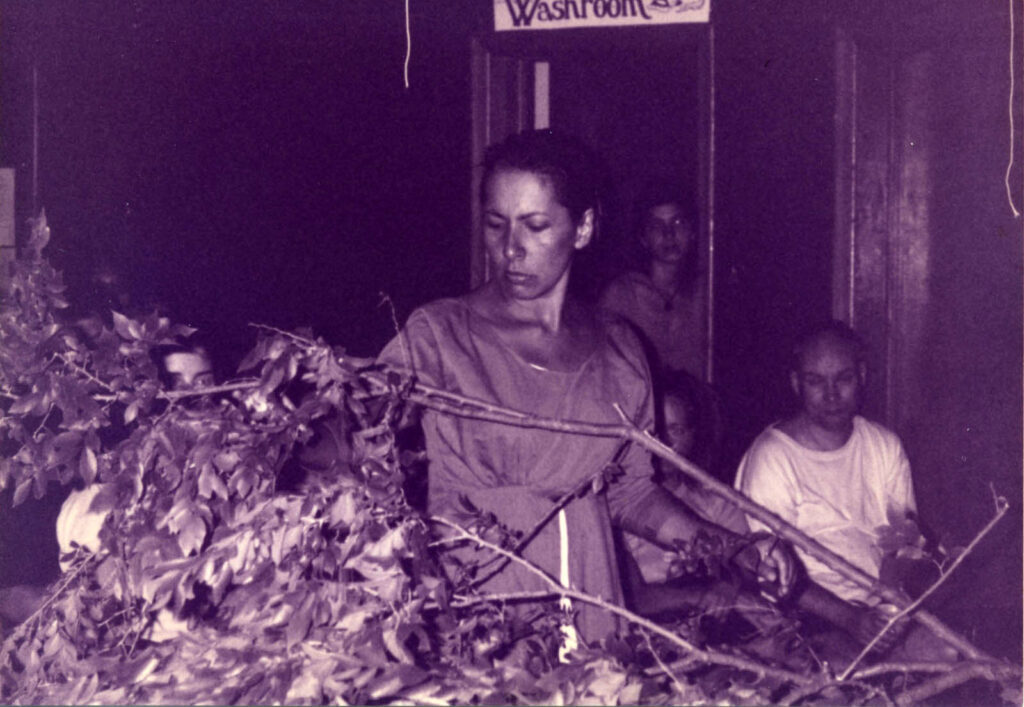
The works of Pam Hall and Ronnie Clarke (responding respectively to works by Fiona Griffiths and Robin Poitras, both featured in the 2019 series KinesTHESES) each connect wonderfully to the specificity of outdoor performance sites. Pam Hall chose to walk in locations near where she is based in Newfoundland. Ronnie Clarke meanwhile documented a sound piece filmed at Ward’s Island Beach in Toronto.
Pam HALL, Walking Home: Riverwalk (one of four videos in the Riverwalk series). 7a*mgr8 2025 © Pam Hall
Fiona GRIFFITHS, body wilderness simulation. VIDEO Paul Couillard © Fiona Griffiths 2019
Each of these pieces query geography, movement, and draw attention to landscape as key to the performance itself. Ronnie Clarke’s reimagining of Robin Poitras’ work was based solely on photographs and recorded audio, as the original work was not filmed. In presenting her response piece to the 7a*mgr8 website, Clarke incorporated a distinctly immersive element to the web page itself. Visitors are invited to play an audio track while viewing images and the recorded video of Clarke’s piece, although the audio is distinct from that of the video. It’s Clarke’s piece therefore that felt most like an interactive performance for website viewers.
I was intrigued by the choices various artists made in selecting works they responded to. Each invited 7a*mgr8 artist was given carte blanche to choose from the digital archive. Some seemed logical, such as Bridget Moser’s choice of a work by Andrew James Paterson. Both Moser and Paterson share an indescribable charm and unassuming quirkiness, both are Toronto-based and long-time contributors to the artist community here. They had in fact both been part of an in-person talk in Toronto in October 2024, during an exhibition of Paterson’s work as an Éminence Grise in the 14th 7a*11d festival. Paul mentioned that he did not discourage any of the selected 7a*mgr8 artists from choosing a work made by someone they knew and rather saw the possibility of new dialogues enriching the ongoing conversations between them.
Two of the selected artists had prior professional contact with those whose work they chose to respond to; SF Ho was taught by Michael Fernandes at NASCAD University and Santiago Tamayo Soler was taught by François Morelli at Concordia University. Throughout Soler and Morelli’s artist talk, their mutual appreciation is palpable. Morelli discussed inviting Soler to his studio prior to filming to view props and items Morelli had kept from his creation of the original work. Ronnie Clarke, k.g. Guttman and Pam Hall all described selecting work based on a feeling of connection to the original pieces when they discovered the work in the 7a*11d website. This has prompted a personal pondering of how digital archives and records of performance generate an emotional response, particularly as I’ve experienced the powerful sensation of interacting with physical archival objects. Is a tactile engagement with archival objects necessary to truly sense their significance? Or is digital interaction sufficient?
SF HO A Solemn Clinic 07-10-2025 (first in a series of 3 videos and 14 images). 7a*mgr8 2025 SF Ho
Michael FERNANDES, Angelic Harp. 7a*11d 2010 © Michael Fernandes
Abedar Kamgari’s piece Cavity, created for the first 7a*mgr8 offering in 2024, was informed by one of the highly specific tactile elements of a 2010 performance by Bojana Videkanic. In Videkanic’s performance, she wrapped herself in a thin layer of dough, which resembled a shroud. In Kamgari’s piece Cavity, performed and documented in Iran in 2024 for 7a*mgr8, Kamgari wrapped herself in a heavy piece of fabric dyed by natural materials available to her at the time. Kamgari mentioned in her artist talk that although her performance was not meant to re-interpret Videkanic’s, the tactile elements such as the dough and the shroud provided points of engagement and sparks for Kamgari’s work.
Abedar KAMGARI, Cavity (site-specific performance). 7a*mgr8 2024. © Abedar Kamgari
Bojana VIDEKANIC, Skin. 7a*11d 2010 © Bojana Videkanic
Tanya Lukin Linklater’s work for 7a*mgr8 Stone, stick, star, also created in 2024, responded to a performance by Rebecca Belmore presented at the first edition of 7a*11d in 1997. Belmore’s work addressed the death of Dudley George, an Indigenous man shot and killed during the Ipperwash Crisis in 1995. There is no video documentation of Belmore’s performance on the website, only a description written by 7a*mgr8 curator Paul Couillard following the performance. Tanya Lukin Linklater’s work, created in collaboration with her daughter, is therefore an even more profound transmission: a continuation of work undertaken in 1997, explored again in 2024, offered to a younger generation learning about complex and difficult histories.
In the third piece created for the first edition of 7a*mgr8 in 2024, almost audio described, performed by Sean Lee, Lee audio described a recording of Lee Wen’s performance for 7a*11d, documented in 2006. Audio description of performance as an accessibility offering is most commonly a polished, edited recording. In Lee’s contribution to 7a*mgr8 the description is organic and imperfect, a key component being the increasing discomfort visible over the course of the 45 minute performance. The two performances seem to overlap – Sean Lee’s audio description, while watching Lee Wen’s performance on a laptop. Although the gesture here is not as directly linked as others in 7a*mgr8, the transmission in these two works occurs on camera both for viewers and for Lee.
Sean LEE, almost audio described (video enactment of audio description by Sean Lee for Lee Wen’s Almost Untitled: End of the World Stories (2006) plus audio file). 7a*mgr8 2024 © Sean Lee
LEE Wen, Almost Untitled: End of the World Stories 7a*11d 2006 © Lee Wen
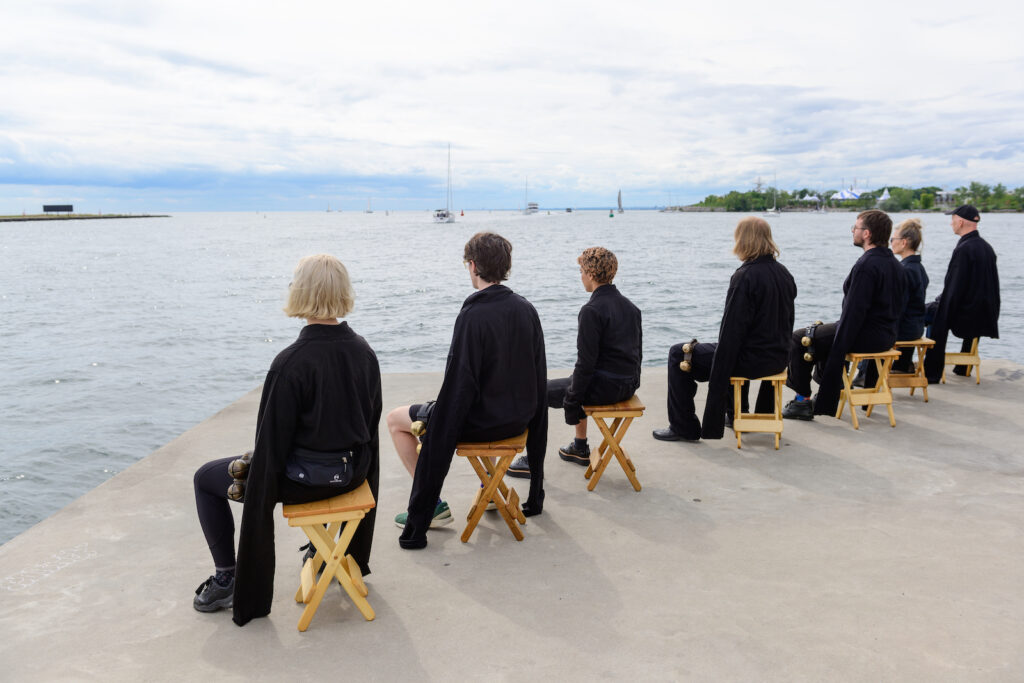
In each of the artist talks Couillard asked the artists to reflect on gesture. The title of 7a*mgr8 is a play on the term “migrate”, attempting to explore the question mentioned above: in exploring histories of performance, what is carried forward? What details or gestures migrate forward over time? Is a sensation or semblance of a past performance work sufficient in communicating its significance into the future? The imaginative approach of the artists selected to participate in 7a*mgr8 have, in a range of ways, done so. The details, or gestures as Couillard calls them, are distinctly present in each response work. A motivating factor in agreeing to write this piece was that I can still clearly remember tiny details I noticed during performances I have attended, even in the distant past (a self-styled, punk drag performer heckling their audience at a late-night event at Vancouver’s Sugar Refinery around 1999/2000, for example) to performances I’ve only heard others describe at past festivals such as 7a*11d or Rhubarb! in Toronto. These of course were often not documented and now live on only as recollections and oral descriptions.
As I watched the performances and artist talks over the span of many months, I was reminded of the earliest days of the COVID-19 pandemic. Performance created to be shared online was a necessity during that time as audiences could not gather and all live events were halted. Performance created solely for presentation online was certainly not new at that time, but with public health stay-at-home orders in place for a large portion of the Western world, performance artists had few alternatives. I’ve spoken with purists in the Toronto performance art community who maintain that performance, in which a shared human experience is central, cannot offer the same engagement for an audience when delivered online. Academic research backs this up: an in-person experience of performance offers more to an audience than simply observing on a screen. However, the accessibility of performances shared digitally has a profound value in being available to audiences anywhere in the world, at any time. I frequently returned to the 7a*mgr8 works and re-watched portions of the artist talks, which would have been impossible had in-person attendance been the only format for attendance.
On April 7, 2020, in the earliest weeks of the COVID-19 pandemic, I watched a transformative virtual town hall titled It Was Always Possible: Centering The Leaders Who Were Here All Along, presented by HowlRound Theatre Commons. The dialogue was led by disability community members involved in theatre who had advocated for many years that live performance events consider or incorporate hybrid delivery, which inherently allows for greater accessibility. The speakers shouted (proverbially) that offering performances to digital audiences was always possible, and yet it was deemed too costly or too difficult. Suddenly, as of that moment in spring of 2020, an array of options was made available to digital audiences, and accessibility was considered in a way it had not been previously.
The 7a*11d digital archive dates begin with the festival’s inception in 1997, so offering performance to digital audiences was not a new consideration for the festival. Accessibility and digital availability is an element of 7a*mgr8 that I see as crucial, despite the present day machinic devouring and sheer volume of digital content being produced and shared online. This notion is also addressed by Pam Hall in her project titled “Toward an Encyclopedia of Local Knowledge”, which was included in the performance she presented at the dinner event I attended in December 2025. The 7a*mgr8 response pieces have taken a step toward that, by making both a valuable contribution to contemporary discourse of Canadian performance art and reflecting on previous performance works. With the mounting challenges in presenting ambitious performance work in the present day, digital performance offerings remain vital. 7a*mgr8 highlights and makes available wonderfully rich knowledge about performance and artistic cultural histories. The project offers new discourse and plants seeds for imagining by both the participating artists and future researchers, scholars, or viewers who can freely engage with the online 7a*11d archive.
Suggested additional readings/viewings
Diana Taylor’s The Archive and the Repertoire: Performing Cultural Memory in the Americas, Duke University Press (2003)
Ann Cvetkovich’s An Archive of Feelings, Duke University Press (2003)
Kerry Francksen and Sophy Smith’s “Live performance in digital environments”, International Journal of Performance Arts and Digital Media 20:1 (2024)
David Román’s “Archival Drag; or, the Afterlife of Performance” in Performance in America: Contemporary U.S. Culture and the Performing Arts, Duke University Press (2005)
It Was Always Possible: Centering the Leaders Who Were Here All Along, an #ArtistResource talk with Rachel Spencer Hewitt (PAAL); Claudia Alick (CallingUP); Ashley Hanson (Department of Public Transformation); and more, HowlRound Theatre Commons
About Jordan King
Jordan King is a Canadian multi-disciplinary artist, curator and writer. Her practice is rooted in performance, archival research and intergenerational dialogue. Jordan’s formative years were spent immersed in nightlife culture, which continues to influence her work and research. Recent curatorial projects have included a performance series at FADO performance art centre and an exhibition of archival material at Toronto’s The ArQuives. Jordan’s writing has been included in PUBLIC Journal and the peer reviewed journal Architecture, Media, Politics, Society, with her photo and video work exhibited at Gallery 44 in Toronto and Factory Media Centre in Hamilton, ON.