

HALL, Pam
Canada

Pam Hall PHOTO courtesy of the artist
Walking Home
Launched December 10, 2025
Three walks in or near St. John’s, Newfoundland: Notes towards a Project Description
Riverwalk- Rennies River Trail from 36 Monskstown Road to Kingsbridge Road, July 10, 2025
Beachwalk– Middle Cove Beach, September 11, 2025
Lakewalk– Quidi Vidi Lake, September 22, 2025
Fiona Griffiths’ “question” in body wilderness was How do we regain a sense of belonging with the earth and air? This wilderness experience happens as you walk mindfully, sit with a tree, listen, look and feel the nature around you and commune with the flora and fauna.
My smaller, anti-spectacle, solitary project Walking Home circles around a similar question… How ARE we HERE? in place? What wilderness is our “regular” home? How do we bring ourselves to mindful presence in whatever “nature” we belong to? My instructions to others are indirect, subtle, ephemeral… a house drawn from sticks, occasionally an arrow or two directing the gaze somewhere… or a word? BE HERE? WAIT AWHILE? LOOK. LISTEN. BREATHE. (This idea about words comes while I am sitting or “sittin'” just being in that place listening to that wind in that light. Like the woman in the station…) Does stillness sharpen our mindfulness? Does familiarity dull the drama of place? Does History murder Mystery?
The little videos are document and invitation to come along. To hear what was heard and see the light and shadows, the water, the small stones underfoot. To perform witness. The camera was a casual companion… not a formal one. Something I needed to SEE… to be WATCHING while I was very seriously watching my steps… I am a fragile walker now… and need to be vigilant about balance on rough ground… so while I was 100% in the walking body, the camera became my watching body… seeing things I did not until much later, or doing the sitting that was part of each walk. Seeing delight through the second pair of eyes….
Every part of these little walks is important — potent. The sticks were cut from a giant linden tree in my city garden, dried in my greenhouse and trimmed in my garden. They are left behind on the walks — becoming the little 6-stick houses of previous projects, or signs, or words. Gifts and instructions at the same time. The walking stick has a long history of being with me on site for the past ten years. The three walks are all water-linked — the North Atlantic beach, the urban river walk, and the long walk around a local lake that I have been making for decades. These are ordinary sites — accessible and banal in the sweetest kind of way. No wild drama, just the neighbourhood wilderness. These are not about spectacle but about being and becoming in place.
Walking Home is a loose and random search for wonder… and for breath. Walking is more difficult for me now but necessary in this wonder-filled process of aging. It brings me not just to presence, to witness, and to being IN Place — but also to recognition, complicity, and belonging TO Place. These are places I have walked for fifty years. They change on multiple temporal scales — momentary, daily, seasonally, yearly and over the almost five decades I have walked these city paths. They are sites of revisitation. They are familiar AND strange — quotidian AND exotic.
Like Fiona, I am interested in the “real” wilderness, AND the idea of wilderness. Can the everyday, ordinary spaces of domestic landscape invite/provoke/reveal the kind of deep connectedness with or embeddedness within Nature (or what we believe it to be)? Like Fiona, I have a pedagogical impulse — a fascination with prompts, instructions, reminders. But unlike Fiona, I did not involve others (as audience or collaborators or witnesses) in these humble, but necessarily unscheduled, walks into my wildernesses close by.
These walks are both a gentle nod towards an impulse I am buoyed to encounter in another artist, and a kind of “response” to the “call” I read in Fiona’s project. A “call” to be present, to be still, and to feel one’s enmeshment in the places where we find ourselves. They (the walks) are also a continuation/iteration of many of the past projects that brought me into profound and gentle relation to site and situation. (The Coil that Binds, Path to the Wishing Place, Marginalia, and of course, the Small Gestures.)
Finally, there is a deeper impulse in these little walks… an impulse of an aging body, finally able to imagine incapacity, immobility or injury — an impulse towards looking more carefully in order to remember — and an impulse to cherish what one might not experience again. Still and always drawn by desire, driven by wonder, and delighted by the next steps.
Pam Hall
St. John’s
October, 2025
Pam Hall is an interdisciplinary artist and scholar whose work has been exhibited and performed site-specifically across Canada and internationally, and is represented in many corporate, private and public collections, including the National Gallery of Canada. Her artistic practice is often research-driven and collaborative and engages communities distant from the pristine spaces of the gallery, the studio, and the museum. She has worked with doctors and medical students, settler and indigenous fishers on both coasts of Canada, workers in the food service and fish processing industries, knowledge-holders in Fogo and Change Islands, Western Newfoundland and Miawpukek/Conne River. Hall’s solo exhibition HouseWork(s) presented a decade of her social and collaborative practice at The Rooms Art Gallery in St. John’s (2014) and in Kamloops, B.C. (2015). She continues to work inside and outside of the museum context and in 2017 was commissioned by the inaugural Bonavista Biennale to create Reseeding the Dream East, an outdoor installation marking the anniversary of the NL cod moratorium, in a Port Rexton meadow. She completed that project during a 2021 residency on Fogo Island. She was the artist-in-residence in the Faculty of Medicine at Memorial University, was their Inaugural Public Engagement Postdoctoral Fellow, and authored a chapter in Performance Studies in Canada (2017), edited by Laura Levin and Marlis Schweitzer. She taught in the MFA in Interdisciplinary Arts Program at Goddard College in Vermont for 16 years and is the creator of the multi-year, multi-chapter art-and-knowledge project Towards an Encyclopedia of Local Knowledge (ELK).
What will we carry forward? (7a*mgr8 review by Jordan King)
Related project: The Work of the Artist-Archivist in the Age of Machinic Devouring
References/Resources
The following references were cited or suggested by Pam Hall and Paul Couillard in Pam’s TPAC interview:
Margaret Dragu: contemporary Canadian artist video, installation, web/analogue publication and performance, based in Vancouver
Marginalia: a four-year collaboration and visual dialogue between Pam Hall and Margaret Dragu
grunt gallery: a Vancouver-based artist-run centre founded in 1984
VAG: the Vancouver Art Gallery, a public visual arts centre founded in 1931
RAG: the Richmond Art Gallery, a municipal art gallery established in 1980 in Richmond, BC
Struts Gallery: an artist-run centre in Sackville, New Brunswick, established in 1980
LIVE Biennale of Performance Art: an artist-driven performance art biennale operating since 1999 in Vancouver
practice theory: a body of theory that explores the significance of practices in human life
performance ethnography: a set of approaches that bring together ethnographic methods and theoretical concepts from performance studies
inshore fishing: a key Newfoundland-Labrador industry
Department of Fisheries and Oceans: now Fisheries and Oceans Canada, the federal institution responsible for managing Canada’s fisheries and oceans resources
Quidi Vidi Lake: a lake located at the east end of St. John’s, Newfoundland
posthumanism: a view that challenges anthropocentric beliefs that place humanity at the centre of existence as the primary measure of value
Middle Cove Beach: a beach near to St. John’s with a rocky shoreline and cliffs providing panoramic views of the Atlantic Ocean
Frank Moore: late U.S. performance artist who was born with cerebral palsy
arkheion: root word from which the word “archive” is derived; Pam references this word in relation to an essay by Jeremy Todd entitled “What does it mean? To get out of the house” in the exhibition catalogue Marginalia: Getting Out of the House (pp. 18-37)
Towards an Encyclopedia of Local Knowledge: a collaborative art-and-knowledge project originated by Pam Hall and engaging hundreds of collaborators in various Newfoundland communities
“Whose Garbage Becomes The Archive? – an interview with Eunsong Kim”: an article from The New Inquiry
“Why Your Kids Don’t Want Your Stuff”: an article encouraging downsizing (not from The Atlantic as attributed in the conversation)
Thích Nhất Hạnh: late Vietnamese Buddhist monk associated with the idea of mindfulness
Philip Auslander: A performance scholar who has explored notions of “liveness” and documentation. In his oft-cited article “The performativity of performance documentation”, Auslander asserts “The purpose of most performance art documentation is to make the artist’s work available to a larger audience, not to capture the performance as an ‘interactional accomplishment’ to which a specific audience and a specific set of performances coming together in specific circumstances make equally significant contributions.”[PAJ 84 (2006): 6] Paul has frequently argued that the “interactional accomplishments” of performance are precisely what interest him as a performance artist; see “Why Performance?” and “Performance Art Documents: An Apologia”
Peggy Phelan: A performance scholar who has argued in her book Unmarked: The Politics of Performance that “Performance’s only life is in the present” [(London: Routledge, 1993): 146]. Daniella Sanader takes up this point in the opening lines of Call and Response, her review of the 2024 7a*11d International Festival of Performance Art.
relational practice: the term “relational aesthetics” was coined by curator Nicolas Bourriaud in the 1990s to describe art based on or inspired by human relations and their social context
Claire Bishop: British art historian who offers a critique of relational aesthetics in her article “Antagonism and Relational Aesthetics”
National Gallery of Canada: Canada’s national art museum, established in 1880 and located in Ottawa
Fogo Island: the largest of the offshore islands of Newfoundland and Labrador; Pam did a residency in the town of Tilting in 2021
Walking Home: Riverwalk
Walking Home: Beachwalk
Walking Home: Lakewalk
Walking Home: Instructions for walking
Pam Hall interviewed by Paul Couillard © Pam Hall, Toronto Performance Art Collective 2025
Canada
Pam Hall, Remaking the Archive SCREEN SHOT ©Pam Hall 2025
Remaking the Archive
Tuesday December 9 6 pm
401 Richmond Street West, Suite 452, Toronto
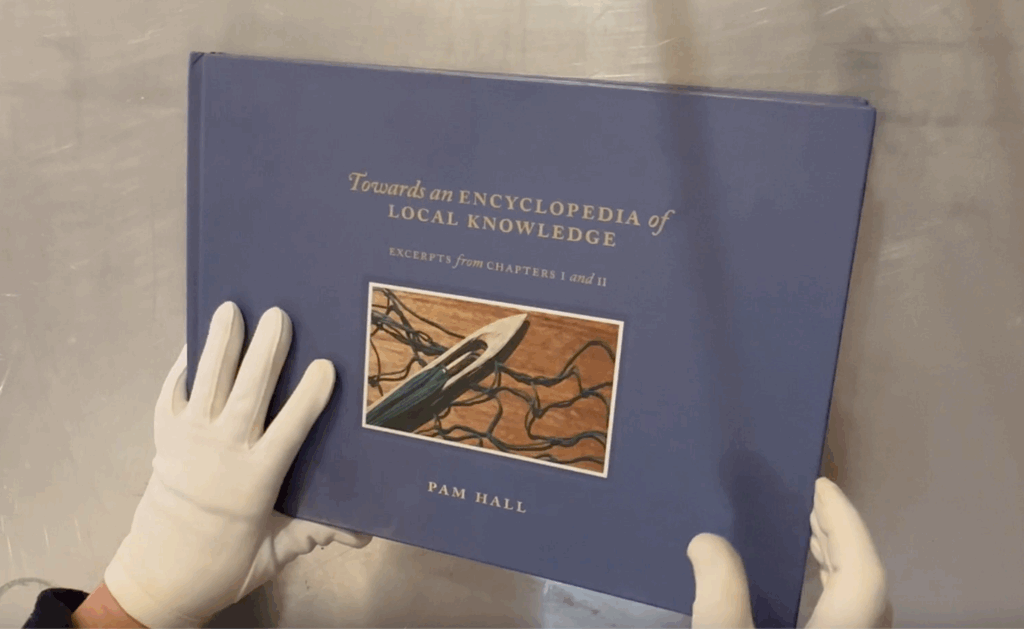
Invited to share a short performance/action/gesture with a group of artists, curators, scholars and students in Toronto, Pam Hall live streamed this new work into their post-dinner gathering and stayed for some questions and conversation. She has for many years been interested in the ideas surrounding “the archive” – who is IN it? How do they enter? How do its inclusions and exclusions determine what we value as knowledge that is important enough to “preserve”? The event was The Work of the Artist-Achivist in the Age of Machinic Devouring, presented by Translocal Action Dialogues on Digital Archives (TADDA), in collaboration with Toronto Performance Art Collective (TPAC). Creating this short action offered me a concise, simple and direct engagement with those questions and invited me into a new way of exploring them. It also advanced the creative explorations that began many years ago in earlier works like Marginalia, Towards the Reading Room, the Gynaeopedia, and the Encyclopedia of Local Knowledge itself. The event took place on the eve of launching another new work, Walking Home, that was commissioned as part of 7a*mgr8.
Pam Hall is an interdisciplinary artist and scholar whose work has been exhibited and performed site-specifically across Canada and internationally, and is represented in many corporate, private and public collections, including the National Gallery of Canada. Her artistic practice is often research-driven and collaborative and engages communities distant from the pristine spaces of the gallery, the studio, and the museum. She has worked with doctors and medical students, settler and indigenous fishers on both coasts of Canada, workers in the food service and fish processing industries, knowledge-holders in Fogo and Change Islands, Western Newfoundland and Miawpukek/Conne River. Hall’s solo exhibition HouseWork(s) presented a decade of her social and collaborative practice at The Rooms Art Gallery in St. John’s (2014) and in Kamloops, B.C. (2015). She continues to work inside and outside of the museum context and in 2017 was commissioned by the inaugural Bonavista Biennale to create Reseeding the Dream East, an outdoor installation marking the anniversary of the NL cod moratorium, in a Port Rexton meadow. She completed that project during a 2021 residency on Fogo Island. She was the artist-in-residence in the Faculty of Medicine at Memorial University, was their Inaugural Public Engagement Postdoctoral Fellow, and authored a chapter in Performance Studies in Canada (2017), edited by Laura Levin and Marlis Schweitzer. She taught in the MFA in Interdisciplinary Arts Program at Goddard College in Vermont for 16 years and is the creator of the multi-year, multi-chapter art-and-knowledge project Towards an Encyclopedia of Local Knowledge (ELK).
Remaking the Archive, Live-streamed performance © Pam Hall 2025