

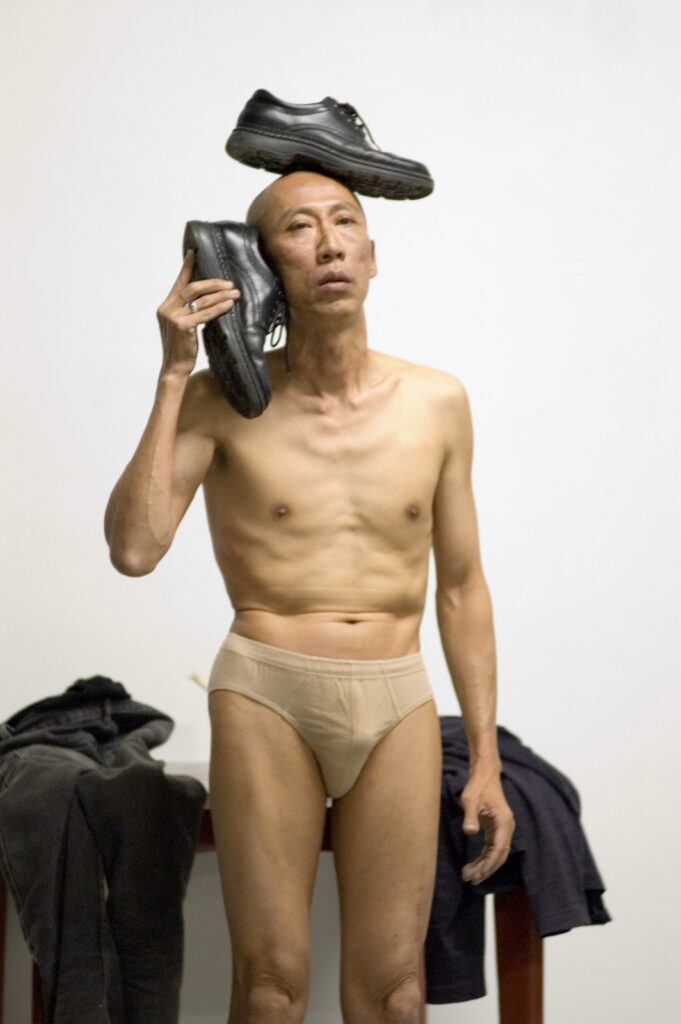
Lee Wen | October 9, 1957 – March 3, 2019
The first time I met Lee Wen, he literally fell into my arms.
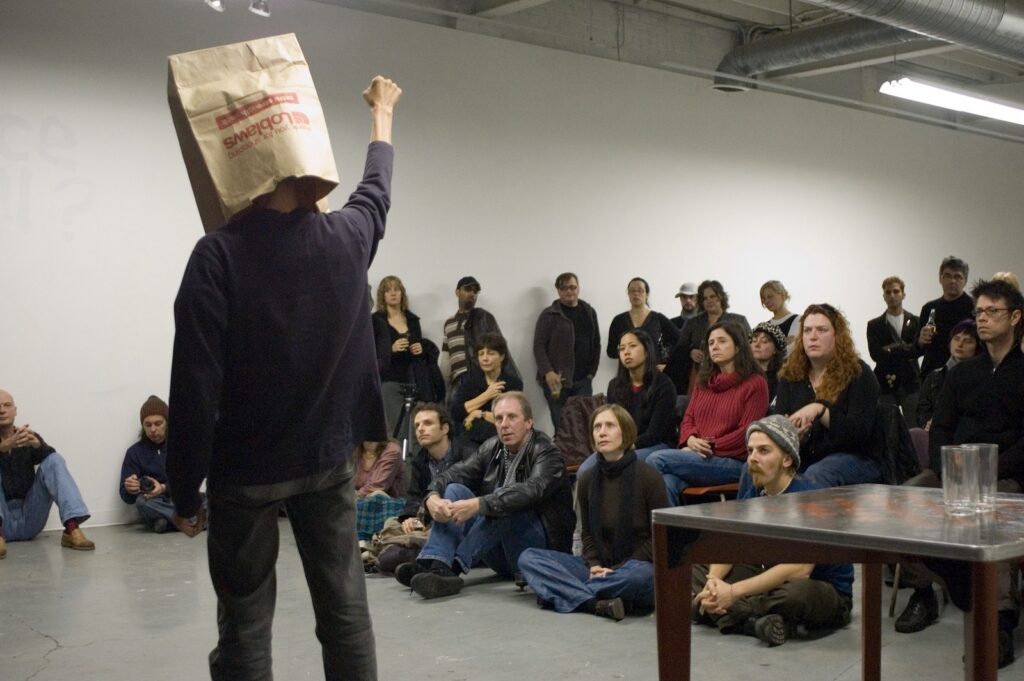
The year was 1996. The place was Le Lieu‘s Rencontre internationale d’art performance et mulitimédia in Quebec City. The room was hot and crowded, and Lee Wen had just performed as part of the opening night event.
My memories of Lee Wen’s performance that night are hazy at best, imperfect glimpses from an awkward sightline as I stood against a peripheral wall while much of the crowd sat on the floor encircling him. What I remember of the performance resembles a disjointed set of snapshots with gaps between the images.
Lee Wen appearing in the performance area in what I would come to recognize as his standard outfit: black jeans, black long-sleeved t-shirt, black socks, black athletic shoes.
A ghetto blaster broadcasting monkey cries while Lee Wen chanted “Kill the chicken, frighten the monkeys,” though this memory only surfaced when I re-read Guy Sioui Durand’s description of the performance in the catalogue supplement that Inter, art actuel published to document the rencontre and its peripheral events.[1]
Lee Wen stripping down to his white underwear, revealing his compact, wiry frame, his amber skin, his skewed back — an action I would see him repeat live and on recordings of performance events from across North America, Europe, and Asia.
Lee Wen attacking a large block of ice with a hammer and sickle, eventually breaking it open. The block burst, and water poured onto the floor from its not-frozen-through centre. Maybe it wasn’t so bad that I didn’t have a close-up view.
Lee Wen in running shorts and a sleeveless white t-shirt, donning a pair of boxing gloves and confronting the audience with the stance of a fighter, an improbable Rocky Balboa.
Lee Wen’s mouth stuffed with chewing gum, a sticky wad that he then used to make figures on the wall. Chewing gum would return as a motif for Lee Wen, figuring prominently, for example, in his performance at 7a*11d ten years later,[2] and also as the single, mangled factoid that defined a country I had not yet visited at the time: In Singapore, it is illegal to chew gum. I remembered Lee Wen’s overstuffed cheeks as I travelled in 2006 to perform at the third iteration of Future of Imagination (FOI) — an annual performance art festival that was initiated by Lee Wen and other Singaporean artists in 2003.
Ater Lee Wen’s Quebec performance, as the audience milled in the space waiting for the next event, I was introduced to him and we began to talk. I was curious about his performance, but hesitant to talk about it, since my view had been somewhat obstructed. Lee Wen was soft-spoken with a distinct Singaporean intonation, and I leaned in close to hear him. We formed a little bubble of English conversation amid a din of animated French voices. Then in mid-conversation, Lee Wen’s eyes began to flutter and roll back into his head. Before I quite understood what was happening, he slumped into me and I instinctively grabbed his limp body. Lee Wen had fainted — presumably the result of jet lag, the heat and closeness of the room, and perhaps the physical strain of his performance. It all happened in a blur, and before most of the crowd had even registered a disturbance, the event organizers whisked him away to a quiet spot to drink some water and regain his composure.
I did not have another chance to talk to Lee Wen on that visit. I think he headed off to Joliette for another performance at Les Ateliers convertibles the following night, and he was not part of the contingent of international artists who travelled to Toronto the following week to perform in Rencontre Performance — a three-day event sponsored by Le Lieu and co-organized by Sandy McFadden, Istvan Kantor and me at CineCycle and Pages Bookstore as a FADO event — which became a key inspiration for the development of the first 7a*11d International Festival of Performance Art the following year. It would be another decade before Lee Wen would appear in Toronto.
Before TPAC[3] was finally able to invite Lee Wen to Toronto in the fall of 2006, I crossed paths with him in several other cities, most notably when he was performing with Black Market International in Berlin in 2005, and then in the spring of 2006 at FOI. Meeting colleagues through the artist-run performance art network is a curious affair. This informal network of ongoing and one-off international events — festivals, projects, series, performance evenings, creative residencies — encompasses astonishing crucibles of artistic innovation and grassroots cultural production. They happen all the time, sometimes in the unlikeliest of places, and with a bit of travel money, it’s possible to traverse the world making performances and experiencing other artists’ work.[4] Each event offers its own dynamic mix of familiar and new faces. For me, this has led to something more than just friendship or colleague relationships. Many of the artists I’ve had the privilege to work alongside have become a diasporic family to me. They are siblings I never had by bloodline but claim by virtue of our deep and intimate interactions.
Lee Wen was a particularly beloved family member: for his performances, of course, but also for his generous mentorship, for his diligent facilitation of performance art activities in multiple countries, and for his eloquent thinking, writing, and speaking about the role of art, artists, and artistic activism in society. Although he was always passionate, he had a calm demeanour, marked by quiet determination and fed by a keen sense of observation coupled with a wry political astuteness. He believed in contributing to the progress of human civilization by nurturing a creative community that could transcend borders and support individual authenticity. As he once outlined his vision: “We may all be luckless survivors on a ship of fools, but we could also be like the Argonauts, ever struggling to repair, remodel, and remake the very ship, the Argus, that carries us on this odyssey that requires constant shifts in order to cross the ever challenging oceans.”[5]
Body-based actions were at the heart of Lee Wen’s prolific art practice, which spanned a gamut of media from prints, drawings and paintings to writing and music. He was both a provocateur and a troubadour, perhaps best known for his recurring exploration of the figure of the Yellow Man, creating a series of works where he would appear covered in yellow paint in an interrogation of racial and ethnic identity from a diasporic Asian context. As a person of Chinese ancestry growing up in Singapore, he was acutely aware of the contradictions of often being perceived as a mainland Chinese man while not being able to speak Mandarin.
The many memorable images I have of Lee Wen and his performances span several decades, most of them tied to specific events, although there is at least one memory of him that I cannot place: Lee Wen circulating through a gallery audience, dragging a durian fruit tied by a cord to his bare leg. Durian, with its distinctive thorny husk, is a controversial food, beloved as a delicacy by many, but reviled by others for its overpowering smell. I remember Lee Wen explaining that he had been surprised to find the durian fruit in a local market. He decided to use it because the fruit prompts such strong reactions and is closely associated with Southeast Asia.
The Lee Wen performance that is most indelibly etched into my memory, however, is The Rite of Spring (Le Sacre du printemps), an evolving performance he presented in various countries between 2009 and 2011.[6] I experienced Lee Wen’s Rite of Spring in October 2009 at Chapel Arts in Vancouver, where it was presented as part of the LIVE Biennale of Performance Art.[7]
Lee Wen’s The Rite of Spring (Le Sacre du Printemps) takes its title from the infamous ballet and orchestral work by Igor Stravinsky, which premiered in Paris in 1913. Lee Wen was drawn to Stravinsky’s work because of its historical significance and the controversy it provoked. He described his motivations in a brief introduction to the version he presented at Open Space in Victoria, British Columbia in 2009, noting how his thoughts about a nearly century-old work intersected with his need to find a new way to perform given his own deteriorating health: “I was trying to be positive about it and trying to think about a new way to work and I thought of how performance art history could be said to be almost a hundred years [old] now. And I was trying to relate to something that was done a hundred years ago.”[8] For Lee Wen, the initial public uproar in Paris surrounding the ballet’s premiere, which is now accepted as a classic twentieth century work, also corresponded to the changing treatment of performance art in Singapore since 2003.[9]
Lee Wen’s artist statement about the work further clarifies his intentions for his own version of The Rite of Spring (Le Sacre du Printemps), which used Stravinsky’s music as its soundtrack:
“Spring begets expectations of changes. It is in the air, the oceans, terra firma and life organisms; in creatures like us. I languidly brazen out that I have a sick body. And so do the earth, the society, and the world. The discoveries of remedies for incurable diseases are confronted with unheard ailments, bugs and viruses, endless conflicts that seem to escalate just when resolution is close at hand, the backlash of rigid bigoted fundamentals recall and stunt the growth of our liberated spirits, relieves us not the Sisyphean task [of] this human existence. I accept it and reject it. I ignore it and deal with it. For changes will not come without challenge and resistance.
“So I will to dance, to activate, to perform the body in sickness, in its primitive urgings, in perennial refutation of tyrannical status quos and repressive fates, seeking resolution of conflicts to mollify the inconsistencies for the reconciliation of contradictions that is yet to be.”[10]
In classic performance art style, Lee Wen’s The Rite of Spring manages to be both spare and monumental. He begins, unassumingly, in a chair, placing a small bag and a few other items beside him and turning on the Stravinsky soundtrack from his cellphone. He is dressed in black street clothes. He pulls out a roll of two large sheets of white paper, perhaps two feet by four feet each. He circles the room unfurling and waving one of the sheets in front of him. The paper floats gracefully in the air, but Lee Wen’s gait is jerky because of his limp, a symptom of the Parkinson’s disease that has begun to affect his ability to move the left side of his body. He lays the paper sheets down to form a long strip along the floor, returns to the chair where he removes his shoes, and then traverses the paper runway from end to end in his socked feet, slowly, carefully, as if the paper were a tightrope. The deliberateness of his movements emphasizes the tension between cautious grace and uncontrollable stutter in his movements. He returns to the chair, strips to his underwear, then pulls a red slip from a bag, which he puts on. The slip is open at the back, revealing the pronounced curve of his spine and ribs, deformed from scoliosis. He takes an apple in each hand, holding his arms out at his sides at shoulder height. He walks forward, barefoot, and tosses the fruit to the audience. Returning to the chair, he picks up a jug of milk and begins to pour milk onto the centre of the white paper, tracing a line from one end to the other. There is quite a lot of milk. Some of it slowly but inexorably seeps off the paper, onto the floor. Returning to the chair, he picks up a piece of paper printed with the words “I WANT TO BE IN YOUR REVOLUTION” in block letters with a black marker. He shows this to the audience, then holds the sign in his mouth as he picks up two local newspapers and walks along the milk-soaked paper runway holding them in front of him, arms outstretched. He chews up the “revolutionary” sign and lays the newspapers on top of the milk-soaked paper. He picks up two long, thick bamboo sticks from beside the chair. Now he circles the room with the bamboo sticks held upright like giant trekking poles, one in each hand, banging them on the floor. He performs a repetitive set of full-body gestures, lunging forward onto one knee as if in supplication, supporting himself with the poles, then standing upright between them, chest thrust forward and head tilted, gazing upward. The forceful thuds of the bamboo sticks striking the floor and Lee Wen’s emphatic corporal poses have an epic feel, emphasizing the contrast between his easy-going, almost mundane preparatory actions and these carefully constructed, formal gestures. After circling the room in this manner, Lee Wen produces two pigs’ feet. He crouches down at the edge of the milk-soaked paper and makes his way along its track as if he were a four-legged creature, the pigs’ feet in his hands forming the front hooves, his own feet following jerkily behind. The combination of materials — milk, pigs’ feet, soggy paper — produces a queasy feeling. After making his way from one end of the paper to the other, Lee Wen melds the images, tying one pig foot to the base of his own leg, and the other to one of the bamboo poles, then repeating his full-body poses, lunging and standing upright. A host of uneasy dualities —between prosaic and poetic, mundane and heroic, sacred and profane, certainly, but also between masculine and feminine, human and animal, pure and adulterated, deliberate and spastic — bleed into one another. He takes the jug and pours out more milk, this time onto the newspapers. He steps onto the newspapers, pigs’ feet now sitting on the floor on either side of him, and jumps up and down repeatedly, arms held high. The heavy hem of the red slip bounces up and down against Lee Wen’s knees as he jumps. The newsprint begins to dissolve, its black ink infusing with the white milk. He crouches down on all fours again and laps at the milk pooled on the floor. Then he takes the two bamboo poles and places one end over each eye socket, planting the other ends precariously onto the soggy paper and leaning his weight into the poles. He stretches his arms out like a bird taking flight, balanced in what is surely a painful suspension. The music ends, and he bows slightly as the crowd claps.[11]
The challenge in describing this performance is to pinpoint its mastery, for it is truly an exceptional work. Part of its power lies in Lee Wen’s unabashed willingness to expose his own vulnerability. Joined as it is to Stravinsky’s music, the performance does indeed take on the challenge of being a ballet, but its vocabulary of fluidity, formal grace, and incisive precision has nothing to do with virtuoso movement or trained dance steps. Lee Wen’s body strives for grand corporal gestures — his arms repeatedly reach out and up, his steps are willful and careful, his spirit extends toward ecstasy and becoming other — but his musculature appears diminished, his torso is distorted, and his left side drags heavily. His synchronization to the music is at best imprecise, only roughly following the score’s overall structure rather than choreographing individual actions to specific notes or musical phrases. His materials are pedestrian — for example, the milk that he pours directly from a plastic supermarket jug. And yet, there is a meticulousness to the way he conflates seeming opposites within the images he constructs. As the tensions pile onto one another, he manages to navigate what might be taken individually as cliche gestures and materials to invoke a complex and improbable rapture. We are transported to another state, a different way of seeing.
And while this work marks something of a departure from his earlier concerns with colonialism, globalization, authoritarianism, and censorship, it remains true to the vision Lee Wen articulated in his master’s thesis, Performance art in Context: A Singaporean Perspective (completed in 2006, the same year he first appeared in Toronto): “To know our identity via one’s own bodily representation is to undermine the received image of those who dominated and imposed on us” (pp. 46-47). With this work, he expands his evocation of the social imaginary, not to set aside his usual concerns with the oppressive force of human institutions, but to supplement his restless questioning and yearning for shared revolution with a new acknowledgment of the urgent precarity of his ailing body.
Perhaps my response to the intensity and poignancy of Lee Wen’s The Rite of Spring is coloured by our shared personal history, which was indelibly marked by the fragility of our performing bodies, marked by illness and congenital defects. The first time I met Lee Wen, he collapsed into my arms after battling with a giant block of ice. When I travelled to Singapore a decade later to participate in the Future of Imagination festival, I accidentally amputated part the middle finger on my left hand during a performance mishap. I was working with a large block of ice weighing several hundred pounds, which slipped and smashed my hands into a concrete floor. The festival organizers reacted with admirable compassion and skill, whisking me away to a superior local hospital where the doctors were able to construct a new (albeit shorter) fingertip for me. Lee Wen in particular was incredibly generous, offering to pay my medical bills (unnecessary, fortunately, since they were covered by my trip insurance), and even making space in the festival schedule for me to bookend this disastrous event, which happened on the opening night of the festival, with a second performance at the closing event where I was able to work through and address some of the trauma I had inadvertently provoked in the audience.
Ever mindful of the systemic forces that work to alienate us from our own authenticity, ever conscious of the sorrow and pain of daily existence, Lee Wen was a tireless champion of a vision of collective liberation and individual self-expression. In his Rite of Spring, Lee Wen signalled to his witnesses that he wanted to be in our revolution. For me, the deeper import of that handwritten notice is the way he welcomed us into his revolution. I am grateful for that invitation and the generosity of spirit he shared with us.
Some Resources:
Lee Wen’s artist page on the TPAC website
Asia Art Archive’s extensive Lee Wen Archive
Lee Wen’s website
Lee Wen’s blog
Lee Wen’s Soundcloud; Lee Wen’s other Soundcloud
[1] See Sioui Durand, Guy. (1996). Trois soirées de rencontres-performances à Québec en octobre. Inter (67) supplemental catalogue, p. 6. https://www.erudit.org/en/journals/inter/1996-n67-inter1114529/60030ac.pdf.
[2] Almost Untitled: End of the World Stories: see https://7a-11d.ca/festival_artist/lee-wen/
[3] Known then (informally) as the 7a*11d collective: incorporation as the Toronto Performance Art Collective (TPAC) did not take place until December of 2012.
[4] Most artist organizers in other countries don’t have the resources to offer artist fees or travel costs, but they will find a way to look after an invited visiting artist’s basic food and accommodation during their stay.
[5] See “A Country with No Names,” June 20, 2023, from Lee Wen’s blog Republic of Daydreams.
[6] See The Rite of Spring (Le Sacre du Printemps) on Lee Wen’s website. The piece premiered in Paris at Infr’action, with later iterations in Poland, Sweden, Belgium, China, Canada, Scotland, Indonesia, and Brazil. This eclectic list of countries gives some sense of the breadth of the international performance art community.
[7] Photo documentation of this performance can be viewed online via the Asia Art Archive site here: https://aaa.org.hk/en/collections/search/archive/lee-wen-archive-2009-open-space-victoria/object/the-rite-of-spring-set-of-37-photographs/sort/title-asc. The archive also includes several video recordings of different versions of the performance.
[8] From my transcription of Lee Wen’s introduction to his performance at Open Space in Victoria as heard in the video documentation. See https://aaa.org.hk/en/collections/search/archive/lee-wen-archive-2009-open-space-victoria/archive/lee-wen-archive-2009-open-space-victoria/object/the-rite-of-spring-le-sacre-du-printemps-188545/sort/title-asc.
[9] Performance art was banned from receiving funding or even being licensed — a legal requirement for public presentations in Singapore — between 1993 and 2003 in the aftermath of a provocative work by Joseph Ng called Brother Cane.
[10] From The Rite of Spring (Le Sacre du Printemps) on Lee Wen’s website. See also footnote 4 above.
[11] Another short eyewitness account of Lee Wen’s performance by Lois Klassen can be found on the LIVE Biennale blog from 2007 – 2012.